Above is the logo of the Common Cause national organization. They’ve recently signed on to supporting lowering the voting age to 16.
For the last several years, young people have been very vocal about expanding their political rights. In an era marked by school violence, racial inequality and a pandemic in the last few years, the push to expand the democratic base by lowering the voting age to 16 has been gaining momentum- and there just might be a way to make that happen through House Joint Resolution 23.
While the issue is not new, debate on it has become more prevalent lately due to recent blue waves in politics and vocal supporters of lowering the voting age. With the emergence of more younger activists who tie in the issue with other issues that they are trying to address, more people are gaining familiarity with the reasons for supporting the move. As of this year, we once again have a bill in Congress to address that- House Joint Resolution 23 (H J Res 23).
Several organizations have been working on this for years, such as NYRA and Vote16USA. In the last few years, even Rock the Vote has signed onto supporting the idea. Other groups like March 4 Our Lives and many climate activists have also done so as well, with many other groups following in their footsteps. Now, Common Cause has joined that list of supporters.
Several branches of Common Cause have already been supporting lowering the voting age to 16 in the last few years, but it has only been until recently that its national component has endorsed the idea. With H. J. Res 23 still waiting for a vote, this is an opportune time for many organizations that have endorsed the idea to make it happen by collaborating on one “common cause”- to enfranchise the next generation of voters so they can better address issues relevant to them.
It is important to note that even with all this support from so many groups, passing H J Res 23 won’t be automatic. People who actively support it, from their own individual initiatives to getting the supportive advocacy of their respective organizations, will be needed if the bill is to be passed once it comes up for a vote. A little coalition building is also necessary beforehand. The latter is what supporters should be doing now- connecting and building further momentum to make sure that H J Res 23 is passed.
It’s been almost two years since the COVID pandemic began. While vaccines & vaccinated people have helped diminish the threat of the pandemic, it hasn’t totally eliminated it. The current problem lies in the ineligible populations, particularly those of young children. However just as important of an obstacle are those that have nothing to do with vaccinations, like failures to impose mask mandates since the recent scho
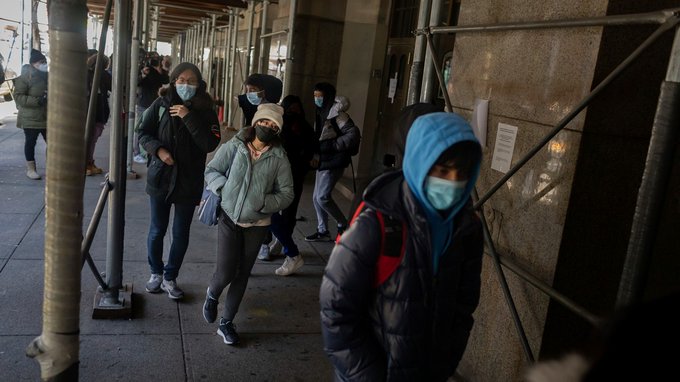
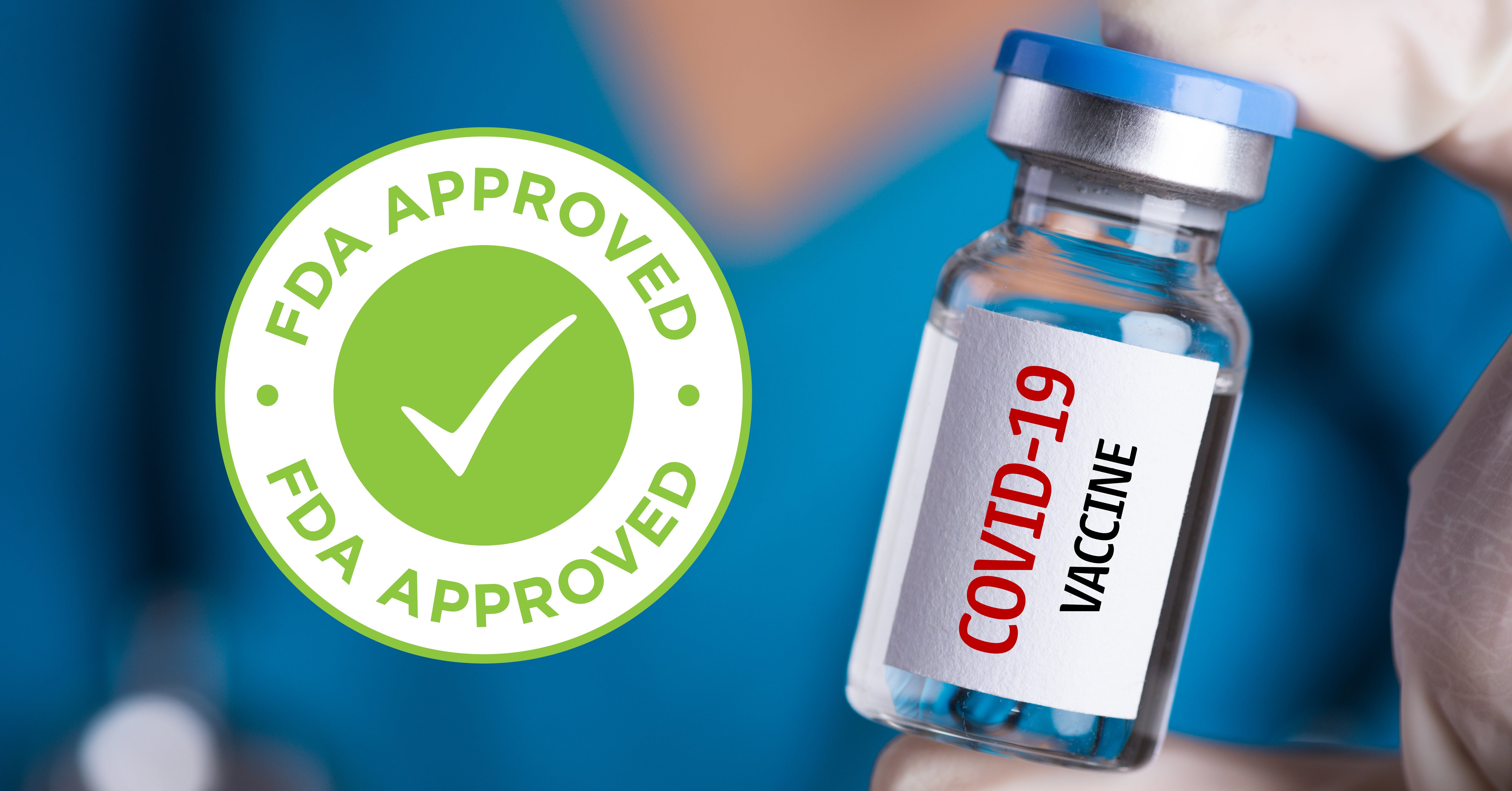
In late August, the FDA finally approved Pfizer’s first COVID-19 vaccine, which had previously been approved for emergency use for those 16 years old and older late last year. It follows the same eligibility mentioned earlier, except now it is an approved vaccine. (photo source)
For the last several weeks, the long awaited FDA approval for a vaccine against the COVID-19 virus has finally been approved.
The approval comes a little more than 8 months since Pfizer’s original vaccine, the Pfizer-BioNTech vaccine, was first introduced in the middle of December of 2020 as an Emergency Use vaccine.
With its approval from the FDA, those in the health field and communities that have been affected by the virus are hoping this will increase interest in those who have not been vaccinated to get the vaccine.
It is also important to point out that, like when the vaccine first introduced for emergency use in 2020, it had been originally approved for those 16 and older. The FDA approval in late August of this year continues that trends, making it also available after its approval for those 16 and older as well.
Young people have been at the front of many issues in the last few years, from school safety, the climate crisis & now the global pandemic. Just like many before them who have contributed to paying their taxes, wondered about their safety at school or the workplace, and the climate issues they will have to deal with tomorrow, they are also helping to combat the pandemic worldwide.
It is highly recommendable that in addition to getting your vaccine against COVID-19, the voting age should also be lowered to accommodate the same voices helping communities answer important issues affecting their local residents, but also the pandemic that has affected the entire world.
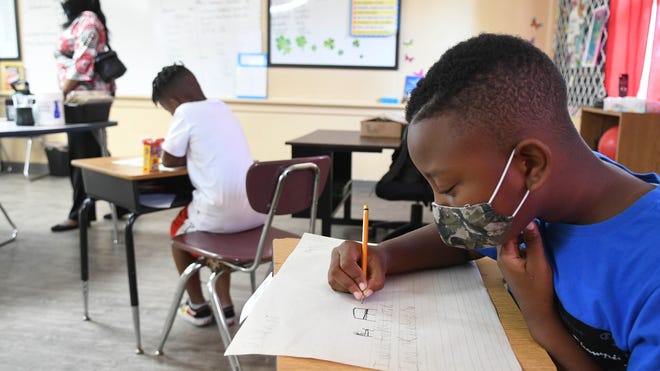
A young student in Florida works on an assignment while wearing a face mask to prevent the spread of COVID-19. The state with one of the highest rates of cases has also had to grapple with the conflict between educators on the local level and Governor Ron DeSantis, with the latter threatening to withhold funding of school boards who refuse to adhere to his ban on mask mandates. (source)
At a time when the COVID-19 pandemic is rapidly spreading across various parts of the U.S., one would think mask mandates would be the way to go to reduce the number of cases, and would receive the support of people from everyone at the local school administrative level to politicians in local office to state leaders. That’s not the case in states like Texas and Florida. The latter getting widespread news coverage in recent days for not just a lack of a statewide mask mandate, but also the words and actions by its current governor, Ron DeSantis
In a move that doesn’t make any sense and threatens to increase more COVID cases in the already pandemic-battered state, Governor DeSantis has threatened to cut salaries of those who defy his executive order ban on state mask mandates. Christina Pushaw, who works as Governor DeSantis’ spokesperson, said on Twitter that “salaries of those superintendents and school board members who intentionally defy the EO(DeSantis’ executive order) and the subsequent rules protecting parents’ rights”. This means that whoever recommends wearing a mask at the local level, therefore defying the ban on mask mandates, could face suspension in pay according to this executive order.
This comes at a time when many people are still facing challenges returning to work, fresh off of a national eviction fight that has been recently extended, and for some, finding work at all. This executive order not only threatens to prevent school board leaders from saving potential lives in their district, but also from those very same people who are acting in the best interests of their students from getting paid, in a setting where not all in their supervision are eligible to get the vaccine yet.
How might this tie-in with the voting age movement? In Governor DeSantis’ spokesperson’s Twitter post, school board members were one of those groups who were threatened with a salary freeze. Recently in CA, school board elections were lowered to 16 for students to be able to vote for their school board members, giving youth some control over who represents their interests in their school districts. Some notable cities include Berkeley with Measure Y1 but also Oakland last year with Measure QQ. In those cases, if those school boards faced the same thing with their counterparts in Florida, those school board members would have been directly elected by youths.
While Florida doesn’t have voting at 16 in either the state or school board elections, it does have a really progressive movement for doing so. Several youth organizations are well-represented in the area. Not only would many young people be affected by their elected school board member not getting paid, but their own immediate health would be threatened if they followed the governor’s recommendation that masks are not needed at this time. This is also during a time when the Delta variant of COVID-19 has started to affect more younger people as those eligible to get vaccinated in older groups are giving less opportunity for COVID to mutate. COVID is starting to move to younger hosts in order to continue being a pandemic.
The story unraveling in Florida shows why it is important to lower the voting age in both local elections and for school board elections because, again, some people in elected office don’t care about the safety and health of the people they oversee and put politics and their own political party above human life.
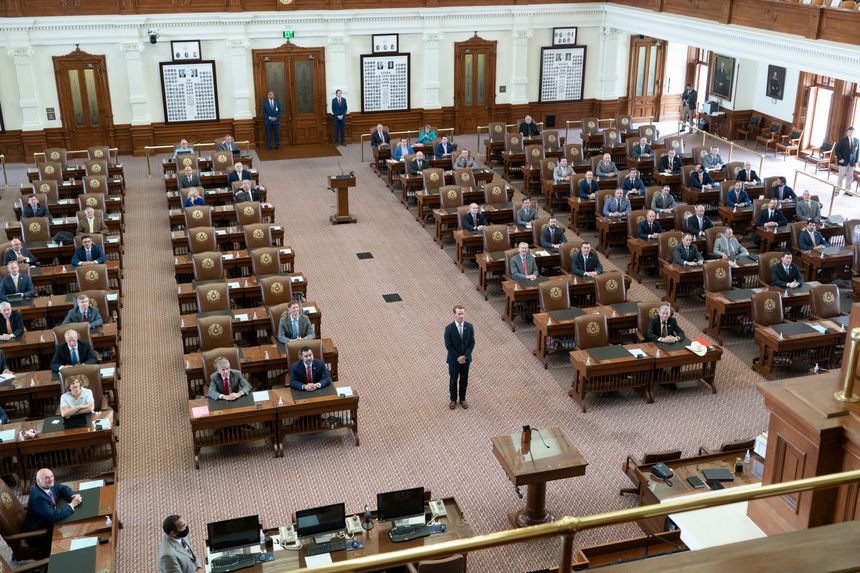
The Texas House floor sits mostly empty as most Texas representatives have fled to Washington D.C.(source)
Last month saw some really interesting voting dynamics for state senators in Washington D.C, but it seems voting antics are not limited to national politics. Even state legislatures are showing some really interesting dynamics.
Unlike their more national peers, Texas Democratic representatives have taken even more drastic measures than the Senators who decided not to vote on a bipartisan commission to investigate the Jan. 6 insurgency last month- the former have taken the extra step of fleeing their districts and have traveled to Washington D.C. for the time being.
Earlier this week, more than 50 Texas Democrat representatives fled the Lone Star State and have sought refuge in Washington D.C. in order to avoid passage of a voting billed from fellow Texas Republican lawmakers that they believe will restrict voting rights. The Democrat representatives in Washington are now calling on Congress to step in and pass a comprehensive voting reform bill to continue to secure voting rights for people in their state and in the nation.
Earlier this summer, 14 states have passed nearly two dozen bills to make voting harder, from eliminating drop boxes to decreasing the number of hours polling places are open. Even more similar bills are being reviewed nationwide. In states like Texas where Democrats don’t have a majority, walkouts might be likely in other states depending on how their local and state governments are set up. Whatever the case might be, this might cause gridlock for any kind of legislation in the future. In order to avoid this, we need representatives who are not in the business of restricting voters rights but expanding democracy.
The best way to do this is comprehensive voting reform. One of those is making sure House Joint Resolution 23 is passed, which would lower the voting age to 16. Many 16 year-olds have not only paid taxes for years, but have also had to live and have contributed a hand in combatting the COVID-19 pandemic that has been affecting communities nationwide. Of course, getting H. R. 1, also known as the “For the People Act” passed is also important. Without these pieces of legislation, partisanship at the level we’ve seen will only continue, making democracy worse.
Passing H J Res 23 not only expands the democracy so that more voters who pay taxes and contribute to local and the national economy are heard, but it would prevent the same individuals like those who are now trying to limit voting rights from being in office again. Knowing who is trying to limit voting rights and people who support these types of legislation should not only be a wake up call to people across the U.S., but also a warning that as long as people like these continue to be in office, then at best, democracy will be in a constant state of gridlock AND, if not addressed promptly, could at worst result in the loss and diminished state of democracy through democratic means.
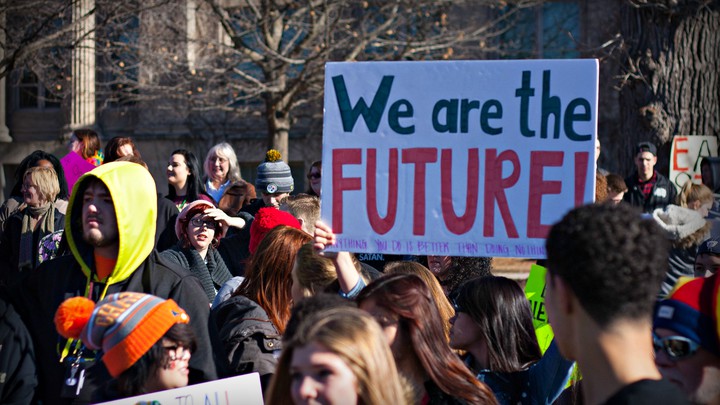
Young people at a protest. One of them is holding a sign that says they are the future. When it comes to voting, it doesn’t seem that way because of the way the voting system is currently set up. (Source)
Last month, several Senators made an unprecedented move when it came to voting on whether or not establish a commission to investigate the January 6th insurrection on the Capitol- they did not vote at all.
While looking into the insurrection earlier this year is an important issue, the topic of voting is the main focus of this post. Rather than taking a side on this issue, it is important to note the topic of voting itself, because there are many ways a vote is scrutinized depending on who does it and what the purpose of it is for.
This was an ironic move because even though there was a majority to support the commission, even with a vote of 54 to 35, with the latter opposition not even two-thirds the size of those in favor, the commission was not formed because 60 votes were needed. Despite clear support and more in support of it, there was no commission.
On the other hand, we currently have H J Res 23- a bill to lower the voting age for people 16 years old and older- with numerous organizations throughout the U.S. who support it. Rather than a job like with the Senators that were elected to do theirs, this vote is for expanding the electorate.
Regardless of whether or not you’re given a vote because it’s your job as a politician or because of a bill passed to enfranchise more people, both types of votes are important. To say that a vote does not matter is to say democracy does not matter. To also deny the vote to someone just because of their young age despite their contributions as a taxpayer and to their local communities with examples is also saying democracy does not matter, in the same way a vote is skipped out on.
We might not be able to fix Congress with a bill, but we can certainly make a difference for young people if H J Res 23 is passed. This is what makes H J Res 23 important and why we should make sure it gets passed.
Whether a youth chooses to vote or not won’t decide the outcome of any piece of legislation in the same way elected officials can. However, giving them the choice to have a vote in the first place gives them the choice whether to vote or not. It should be up to them. It’s not a job, it’s choice, and they should be given the option whether to weigh in on issues that affect them or not. Please support H J Res 23 so young people can finally have a vote.
H J Res 23 is the bill that Rep. Grace Meng introduced in February to lower the federal voting age. It is still currently waiting for a vote in the House of Representatives.
At this time, organizations spanning coast to coast in the United States that have worked on previous efforts to lower the voting age in several cities in their areas, as well as even state and national efforts, are collaborating to work on campaigning for H J Res 23, which is expected for a vote in the near future. It has recently been moved up for consideration to a subcommittee that will determine when it will be discussed and voted on.
In the meantime, a recently completed youth forum that collaborating organizations have joined is adding members to discuss how to support the H J Res 23 bill. All kinds of skills are needed, from graphic arts design to social media skills. Networking has also been a helpful tool, with many organizations connecting national efforts to local chapters and branches as well. However, more help is welcome and needed at this time while H J Res 23 waits for discussion on the House Floor.
If you have not already signed up for the youth forum, please contact me, since I can help get you an invite. It is important that supporters of lowering the voting age, no matter if your efforts have been localized to your nearby cities, slightly larger through counties or even statewide efforts, and especially national campaigns, band together to get H J Res 23 passed. Thank you.
Hi everyone. My name is Jester Jersey and I am a supporter of lowering the voting age.
If you just joined, I won’t make long posts like this on the forum, but use this page as an informational base regarding what the forum will be about. I’ll also add links here that are relative to the forum every now and then, and you can reach out to me or the other moderators if you have questions after you join. I hope we can all get along and work together on the common goal to lower the voting age to 16 within the United States.
Like many people who received the invite to join the forum, readers are probably aware of the current bill by Rep. Grace Meng to lower the voting age. It’s basically a reintroduction of an amendment introduced by Rep. Ayanna Pressley in the 2019 version of the bill 2 years ago. At that time, there were only days between when the amendment was introduced to when it was given a final vote. Although it unfortunately failed, H J Res 23 gives us another opportunity to change the course of history. This is what the forum you’ve been invited to will focus on.
I am one of the admins of the new forum that you just joined, called the Campaign Coalition for House Joint Resolution 23 (H J Res 23). As the namesake implies, it is an active forum where the coalition talks strategically on how to get bills like H J Res 23 passed, not one where we just discuss good arguments or put up news about lowering the voting age. We do this, and then some.
One of the things that troubled me about the movement in general is that although there are many good groups working towards this issue, there is currently very little collaboration or talks of one for HJ Res 23. Rep. Meng’s bill can have the potential to change many things for youth rights supporters- even if it only enfranchises youth at the federal level, it could bring attention to many local and state efforts.
Although it might not automatically lower the voting age in your region, I would assume it would make it easier to effect change from the top down since we would be collectively aware of a national effort rather than hundreds of separate efforts. It would be overwhelming for smaller groups and even more so for individual members to keep tracks of several dozen efforts. However, with H J Res 23, we can collaborate on a more concentrated effort because we know key players and can form one comprehensive and consolidated strategy rather than many smaller strategies and spread out resources thinly. This is probably one of the best strategies we can use right now.
As a fellow supporter, I am not saying you should abandon your local efforts to lower the voting age, whether it is a local or municipal effort. If anything, I would encourage readers to get even more involved in the efforts near you. However, if we can successfully get H J Res 23 passed, local movements can use it as a reference point to say the vote was expanded federally, so why not locally and/or statewide? It could possibly provide a domino effect and finally encourage cities to lower their voting age even if there is no local movement nearby.
Rather than working separately, we should work together across state borders so we can do something together. This is why the forum was created- to create solidarity with each other. Even though there are big groups in the movement working on the issue, compared to other issues that focus on gender equity, racial equity, even climate issues, we’re a really small group. If you add the large size of the U.S. into account, it can feel really isolating. But our common goal to lower the voting age to 16 along with Rep. Meng’s bill has the potential to unite us and help our respective movements no matter where we’re located.
I look forward to working with those who’ve joined the forum. I don’t have all the answer, and maybe you don’t either. I hope that together, with the efforts we’re involved in along with your personal contributions, organizations and network reach, we can finally, definitively answer that question on whether we should enfranchise 16-year olds, and by lowering the voting age to 16 nationally, begin address the issues that affect today’s youth!
Patrick Henry giving a speech on March 23rd, 1775 at the Second Virginia Convention. This is the same speech he is most famously known for uttering the phrase “Give me liberty or give me death!” (source)
Although yesterday was supposed to be the regular due date for taxes, the IRS has extended the filing season by almost a month, with the last day to file taxes on May 17th of this year. The delay has been attributed to the COVID-19 pandemic, which has interrupted many facets of living in the U.S. since it was declared a pandemic more than a year ago.
Taxes, no matter what day they are due, are nothing new. In the introductory graphic above, Patrick Henry gives his most famous speech at the Second Virginia Convention where he also famously uttered the words “Give me liberty or give me death” to protest the Stamp Act that the British previously passed taxing American Colonists a decade earlier, in 1765. A transcript of the entire speech can be found here.
However, in modern times, we still have no representation for a certain marginalized group that is fighting to get a vote for their paid taxes: 16-year old taxpayers.
Unlike in Patrick Henry’s day nearly 225 years ago, a war is not necessarily needed to be waged to get young people the vote, but that doesn’t mean it will be easily given either. Instead of fighting, we’re working through advocacy- we have many organizations working together around the world, and in the U.S., coast to coast from the Atlantic to the Pacific, to enfranchise more youth. Like the colonists of Patrick Henry’s day, taxation without representation continues to oppress our youth. As supporters of lowering the voting age, we need to fight this injustice.
For my part, I have provided a social media blueprint to help with that endeavor, using my skills as a social media contributor from my previous experience working with Twitter. Obviously, it will take more than posting online on social media to effect change. But if used efficiently and effectively, it can be a powerful tool in the arsenal of youth rights and lower voting age supporters all around the world.
Not only can it help bring awareness to those unaware of the movement, but it can also help gather and unite allies to inform them who we are and what we’re trying to do. Social media platforms are the best mediums we can use at this time as the world slowly opens up again after being sheltered in place from the COVID-19 pandemic.
As I’ve mentioned in previous posts, this is an optimal time to make change happen. We have the legislative tools and supportive politicians we need, but we have to campaign for the success of this bill, regardless of where our organizational loyalties are. Lowering the voting age is enough of a motivator to campaign for H J Res 23. This is why we have to use the tools we have to advocate for it- social media is one of those tools.
We’re also at the edge of losing one of our most supportive voices in government, Speaker Nancy Pelosi. We cannot predict whether this is indeed her last term as suggested by some. At the same time, even if that is not the case, there are still issues that youth will have to deal with without a vote, unless H J Res 23 is passed.
The point is, regardless of who the Speaker of the House is, which representatives represent your district and who your two state senators, whatever issues affect youth will continue to affect them unless they have a voice to say otherwise. The quicker they can achieve a voice, the quicker they can address those issues through voting. With the current political climate, it would seem easier to put all our resources into this and get this done now while we can.
Not only have youths without a vote had to tackle the issues that many organizations are trying to address now, but like many of us who can vote, youth have had to live through and continue to live through the unprecedented times of the COVID-19 pandemic. This development has also brought on a new dynamic to the dialogue- traditional employments for youth has been severely affected due to the closure of many leisure venues like restaurants, fast food places and other places where youth could have been employed had the pandemic not taken hold.
Many youth have also been affected in their educational and career paths. Schools may have had to make decisions as to how to proceed during the pandemic, whether this be what courses to remove from a school’s class offerings, what resources are available to students if they are required to learn from home and even school events affected by the pandemic. Decisions around these have had little input from students except for a few places that have included student opinion on their school boards.
Finally, even the dilemma of fighting the pandemic itself has brought the idea of even medical autonomy for many 16-year olds to decide for themselves whether or not they wish to take a vaccine in order to avoid getting COVID-19 and passing it to others. First, this began to emerge as one of the first vaccines began being made available at the end of last year and now as the vaccine eligibility continues to open up, with the start of next week, April 19th, as being the day when eligibility is opened up for most individuals 16-years old and older in most states.
As Patrick Henry protested the Stamp Act in 1775, so to do we need to act on finally lowering the voting age to 16. I have outlined my argument for doing so as best as I can. In a recent call among ally organizations, a question was posed as to what the best reason to lower the voting age is. I had replied that taxation was one big reason. Since then, so many reasons have been discussed, including many I have addressed in the previous paragraphs.
There are so many things going for the movement. We have the momentum, motivation most optimal and opportune time to do this, and most collaborative group by far compared to previous attempts. We should make sure that this opportunity does not go to waste. All we have to do is work together- we have all the tools and resources we need to make this all happen. Let’s enfranchise more youth together!
There are many movements right now to address issues that affect both young and old people. But those who have a say lean disproportionately to favor older individuals that aren’t as ethnically diverse and who’s concerns don’t always align with needs of a younger, more diverse crowd that will have to live longer with choices made that they had no say in.
Issues affect many people throughout life. Depending on where you are in your education, career or life stage, many issues will affect you. Unfortunately, not all people can have a say in what course those effects will have on them.
Recent laws have been trying to suppress the vote, something that has been fought for by the people for years. Many of these people who worked to make a better democracy for all have been historically marginalized groups: women, minorities, even people with disabilities, and in some cases, mix or all of the above. But another just as important group that are marginalized are the youth of today.
It is often said that today’s young people are the leaders of tomorrow. But that doesn’t feel like it. They’re affected by many decisions that they don’t have a say in, by people they didn’t elect, and sometimes, funded by the very funds they contributed as a taxpayer in their local economy through an income tax from employment. Even more so through sales taxes. However, there is no accompanying vote. This has to change.
The COVID-19 pandemic has really changed the way we see enfranchisement and the role many 16-year olds are playing in this environment. Like their older peers, they too have been affected by the closures of school, business and career opportunities. However, thanks to Pfizer-Biontech, they have been given an opportunity to participate in the fight against the COVID-19 virus. Despite this, there is still no vote for most 16-year olds, unless you’re lucky enough to live in a few select cities in Maryland. Even then, there are few opportunities to mobilize change outside your immediate “Earth-sphere”- issues that might be important to you that you have solved might not have been solved if you move to another city to go to school, work at a job or even to volunteer. A vote for all those in the taxpaying populace can make sure you can take the potential to effect change with you.
While there is hope now that Rep. Grace Meng of New York has again called for lowering the Federal voting age through H J Res 23, we might also be seeing one of the prime supporters of lowering the voting age, House Speaker Nancy Pelosi, in her last term as Speaker. If so, we do not know who will be her replacement, or how friendly towards lowering the voting age to 16 her next successor will be. Because of this, we need to act now to make sure that it is passed so we can give a voice to our young people.
Why is this urgent? There are many reasons, but consider what could happen if H J Res 23 is not passed:
Young people will miss out on the next few years to weigh in on issues that affect them today. This could range from a variety of issues, such as:
climate issues
school safety/violence
local representation
taxation, representation, etc.
As mentioned above, we don’t know how long the third highest politician in the land will be Speaker, much less how supportive her successor will be. We don’t even know if the majorities in the House of Representatives and Senate, the latter already being slim as it is, will hold.The same goes for the two top positions in government as well. There is too much political uncertainty to not prioritize this at this time.
Organizations that have already been working on lowering the voting age will have to start from square one again. We would have to rebuild momentum, wait a period of time again while youth will also have to continually deal with the issues they don’t have a say in and everyone else might have to possibly deal with other unknown issues, like another pandemic. Most efforts will only be local, and won’t be have a significant impact as H J Res 23 would. Even if small cities were somehow able to pass legislation in their local jurisdictions to lower the voting age, this would leave pockets of unenfranchisement throughout the U.S.
But on the bright side, we have the momentum, supportive people in office and more collaboration going for us. We also have a better appreciation for the role youth are playing even in this pandemic environment, something that we’ve never had to deal with in recent memory. We should take advantage of that momentum, the political current and current events in order to lower the voting age to 16. By giving a vote to the youth who are being affected by issues ranging from their school environment to the pandemic, from their home city to both coasts, youth can make can make political choices on issues that matter to them. H J Res 23 can address all of these. We have the framework and people now, so we should go for it.
Various organizations have began collaborating on a plan to support lowering the voting age to 16 in regards to H J Res 23, which is our best bet right now to enfranchise more youth, not only in one part of the U.S. but the whole country. Of course, it isn’t the only piece of legislation aimed at lowering the voting age, but if I listed every single one, you would need to do way more reading. Also, strategically, it is easier to effect change from the top down(i.e. Speaker Pelosi) than work our way up(smaller movements with little attention).
Right now, many groups are focused on the passage of H J Res 23 because it dwarfs all the other legislation out there. H J Res 23 can be a game changer if it is passed for many issues youth are invested in, like climate and school safety, but also pandemic-related events, like how they’re affected by transitioning to remote learning and weighing in on whether they would feel safe returning to school to name just a few. Because of this, we want to focus on making that successful. Like in the top-down example, the conflict is whether we enfranchise youth or not. Without a vote, regardless of the issue they want to weigh in on, they won’t be able to. If given a vote, they can weigh in on something as mundane as what wattage light bulb they want to use to illuminate their classrooms in a post-COVID learning environment to more serious, relevant issues like what form of remote learning might take if another pandemic happens in the future.
I’ve been in touch with other organizations and would like to collaborate with others if we’re not already doing so. Even if your focus isn’t on lowering the voting age or only on lowering the voting age or if it’s a combination of both, no matter what your goal is, the point of most youth-based organizations is to give their supporters a voice. The issues might differ, but if the current ways of doing things were okay and the people in these movements were satisfied, then there wouldn’t need to be any movements to change the status quo. Obviously this isn’t so, which is why we have organizations to make a difference. Many such organizations are backed by young supporters.
Now is not the time to focus on our differences, but the common goal to enfranchise more youth into active democratic participation and make a difference in the lives of youth today. It is crucial we work together so that young people can advocate for their own needs rather than someone imposing their views on them and shaping the political landscape around them.
As long as your organization is focused on making a difference, powered by youth, pro-youth and willing to work with other organizations to collaborate, I think there is a potential to work together. We might even be able to help you out on your particular issues, find commonalities in our strategies and even share resources. Regardless of the issue, getting a voice and a vote for our young people who do not have one can make a difference in what our society will look like the next few years. It is crucial that we work together on this so that young people can advocate for their own needs.
If we can connect with those at your particular organization’s leadership, I can facilitate contact with some of the top leadership at NYRA, Vote16USA and many others as well- we’re working on a plan to enfranchise more youth through a new campaign. All who can help and are willing to help are welcome. I can also connect you to organizations we are working with on this issue. This is a great time to seize the moment to enfranchise more youth.
Through our collaborative efforts and plan in place, we just might be able to get the vote for the young people powering our organizations, at a favorable time for all our movements, on issues that affect young people today, to make positive change and effect real change. I hope you can join us to make this happen. If you want to help, please get in touch with with me as soon as possible! Thank you.