H J Res 23 is the bill that Rep. Grace Meng introduced in February to lower the federal voting age. It is still currently waiting for a vote in the House of Representatives.
At this time, organizations spanning coast to coast in the United States that have worked on previous efforts to lower the voting age in several cities in their areas, as well as even state and national efforts, are collaborating to work on campaigning for H J Res 23, which is expected for a vote in the near future. It has recently been moved up for consideration to a subcommittee that will determine when it will be discussed and voted on.
In the meantime, a recently completed youth forum that collaborating organizations have joined is adding members to discuss how to support the H J Res 23 bill. All kinds of skills are needed, from graphic arts design to social media skills. Networking has also been a helpful tool, with many organizations connecting national efforts to local chapters and branches as well. However, more help is welcome and needed at this time while H J Res 23 waits for discussion on the House Floor.
If you have not already signed up for the youth forum, please contact me, since I can help get you an invite. It is important that supporters of lowering the voting age, no matter if your efforts have been localized to your nearby cities, slightly larger through counties or even statewide efforts, and especially national campaigns, band together to get H J Res 23 passed. Thank you.
Hi everyone. My name is Jester Jersey and I am a supporter of lowering the voting age.
If you just joined, I won’t make long posts like this on the forum, but use this page as an informational base regarding what the forum will be about. I’ll also add links here that are relative to the forum every now and then, and you can reach out to me or the other moderators if you have questions after you join. I hope we can all get along and work together on the common goal to lower the voting age to 16 within the United States.
Like many people who received the invite to join the forum, readers are probably aware of the current bill by Rep. Grace Meng to lower the voting age. It’s basically a reintroduction of an amendment introduced by Rep. Ayanna Pressley in the 2019 version of the bill 2 years ago. At that time, there were only days between when the amendment was introduced to when it was given a final vote. Although it unfortunately failed, H J Res 23 gives us another opportunity to change the course of history. This is what the forum you’ve been invited to will focus on.
I am one of the admins of the new forum that you just joined, called the Campaign Coalition for House Joint Resolution 23 (H J Res 23). As the namesake implies, it is an active forum where the coalition talks strategically on how to get bills like H J Res 23 passed, not one where we just discuss good arguments or put up news about lowering the voting age. We do this, and then some.
One of the things that troubled me about the movement in general is that although there are many good groups working towards this issue, there is currently very little collaboration or talks of one for HJ Res 23. Rep. Meng’s bill can have the potential to change many things for youth rights supporters- even if it only enfranchises youth at the federal level, it could bring attention to many local and state efforts.
Although it might not automatically lower the voting age in your region, I would assume it would make it easier to effect change from the top down since we would be collectively aware of a national effort rather than hundreds of separate efforts. It would be overwhelming for smaller groups and even more so for individual members to keep tracks of several dozen efforts. However, with H J Res 23, we can collaborate on a more concentrated effort because we know key players and can form one comprehensive and consolidated strategy rather than many smaller strategies and spread out resources thinly. This is probably one of the best strategies we can use right now.
As a fellow supporter, I am not saying you should abandon your local efforts to lower the voting age, whether it is a local or municipal effort. If anything, I would encourage readers to get even more involved in the efforts near you. However, if we can successfully get H J Res 23 passed, local movements can use it as a reference point to say the vote was expanded federally, so why not locally and/or statewide? It could possibly provide a domino effect and finally encourage cities to lower their voting age even if there is no local movement nearby.
Rather than working separately, we should work together across state borders so we can do something together. This is why the forum was created- to create solidarity with each other. Even though there are big groups in the movement working on the issue, compared to other issues that focus on gender equity, racial equity, even climate issues, we’re a really small group. If you add the large size of the U.S. into account, it can feel really isolating. But our common goal to lower the voting age to 16 along with Rep. Meng’s bill has the potential to unite us and help our respective movements no matter where we’re located.
I look forward to working with those who’ve joined the forum. I don’t have all the answer, and maybe you don’t either. I hope that together, with the efforts we’re involved in along with your personal contributions, organizations and network reach, we can finally, definitively answer that question on whether we should enfranchise 16-year olds, and by lowering the voting age to 16 nationally, begin address the issues that affect today’s youth!
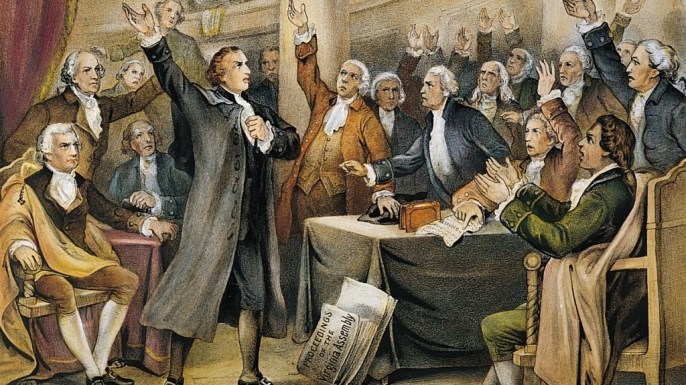
Patrick Henry giving a speech on March 23rd, 1775 at the Second Virginia Convention. This is the same speech he is most famously known for uttering the phrase “Give me liberty or give me death!” (source)
Although yesterday was supposed to be the regular due date for taxes, the IRS has extended the filing season by almost a month, with the last day to file taxes on May 17th of this year. The delay has been attributed to the COVID-19 pandemic, which has interrupted many facets of living in the U.S. since it was declared a pandemic more than a year ago.
Taxes, no matter what day they are due, are nothing new. In the introductory graphic above, Patrick Henry gives his most famous speech at the Second Virginia Convention where he also famously uttered the words “Give me liberty or give me death” to protest the Stamp Act that the British previously passed taxing American Colonists a decade earlier, in 1765. A transcript of the entire speech can be found here.
However, in modern times, we still have no representation for a certain marginalized group that is fighting to get a vote for their paid taxes: 16-year old taxpayers.
Unlike in Patrick Henry’s day nearly 225 years ago, a war is not necessarily needed to be waged to get young people the vote, but that doesn’t mean it will be easily given either. Instead of fighting, we’re working through advocacy- we have many organizations working together around the world, and in the U.S., coast to coast from the Atlantic to the Pacific, to enfranchise more youth. Like the colonists of Patrick Henry’s day, taxation without representation continues to oppress our youth. As supporters of lowering the voting age, we need to fight this injustice.
For my part, I have provided a social media blueprint to help with that endeavor, using my skills as a social media contributor from my previous experience working with Twitter. Obviously, it will take more than posting online on social media to effect change. But if used efficiently and effectively, it can be a powerful tool in the arsenal of youth rights and lower voting age supporters all around the world.
Not only can it help bring awareness to those unaware of the movement, but it can also help gather and unite allies to inform them who we are and what we’re trying to do. Social media platforms are the best mediums we can use at this time as the world slowly opens up again after being sheltered in place from the COVID-19 pandemic.
As I’ve mentioned in previous posts, this is an optimal time to make change happen. We have the legislative tools and supportive politicians we need, but we have to campaign for the success of this bill, regardless of where our organizational loyalties are. Lowering the voting age is enough of a motivator to campaign for H J Res 23. This is why we have to use the tools we have to advocate for it- social media is one of those tools.
We’re also at the edge of losing one of our most supportive voices in government, Speaker Nancy Pelosi. We cannot predict whether this is indeed her last term as suggested by some. At the same time, even if that is not the case, there are still issues that youth will have to deal with without a vote, unless H J Res 23 is passed.
The point is, regardless of who the Speaker of the House is, which representatives represent your district and who your two state senators, whatever issues affect youth will continue to affect them unless they have a voice to say otherwise. The quicker they can achieve a voice, the quicker they can address those issues through voting. With the current political climate, it would seem easier to put all our resources into this and get this done now while we can.
Not only have youths without a vote had to tackle the issues that many organizations are trying to address now, but like many of us who can vote, youth have had to live through and continue to live through the unprecedented times of the COVID-19 pandemic. This development has also brought on a new dynamic to the dialogue- traditional employments for youth has been severely affected due to the closure of many leisure venues like restaurants, fast food places and other places where youth could have been employed had the pandemic not taken hold.
Many youth have also been affected in their educational and career paths. Schools may have had to make decisions as to how to proceed during the pandemic, whether this be what courses to remove from a school’s class offerings, what resources are available to students if they are required to learn from home and even school events affected by the pandemic. Decisions around these have had little input from students except for a few places that have included student opinion on their school boards.
Finally, even the dilemma of fighting the pandemic itself has brought the idea of even medical autonomy for many 16-year olds to decide for themselves whether or not they wish to take a vaccine in order to avoid getting COVID-19 and passing it to others. First, this began to emerge as one of the first vaccines began being made available at the end of last year and now as the vaccine eligibility continues to open up, with the start of next week, April 19th, as being the day when eligibility is opened up for most individuals 16-years old and older in most states.
As Patrick Henry protested the Stamp Act in 1775, so to do we need to act on finally lowering the voting age to 16. I have outlined my argument for doing so as best as I can. In a recent call among ally organizations, a question was posed as to what the best reason to lower the voting age is. I had replied that taxation was one big reason. Since then, so many reasons have been discussed, including many I have addressed in the previous paragraphs.
There are so many things going for the movement. We have the momentum, motivation most optimal and opportune time to do this, and most collaborative group by far compared to previous attempts. We should make sure that this opportunity does not go to waste. All we have to do is work together- we have all the tools and resources we need to make this all happen. Let’s enfranchise more youth together!
There are many movements right now to address issues that affect both young and old people. But those who have a say lean disproportionately to favor older individuals that aren’t as ethnically diverse and who’s concerns don’t always align with needs of a younger, more diverse crowd that will have to live longer with choices made that they had no say in.
Issues affect many people throughout life. Depending on where you are in your education, career or life stage, many issues will affect you. Unfortunately, not all people can have a say in what course those effects will have on them.
Recent laws have been trying to suppress the vote, something that has been fought for by the people for years. Many of these people who worked to make a better democracy for all have been historically marginalized groups: women, minorities, even people with disabilities, and in some cases, mix or all of the above. But another just as important group that are marginalized are the youth of today.
It is often said that today’s young people are the leaders of tomorrow. But that doesn’t feel like it. They’re affected by many decisions that they don’t have a say in, by people they didn’t elect, and sometimes, funded by the very funds they contributed as a taxpayer in their local economy through an income tax from employment. Even more so through sales taxes. However, there is no accompanying vote. This has to change.
The COVID-19 pandemic has really changed the way we see enfranchisement and the role many 16-year olds are playing in this environment. Like their older peers, they too have been affected by the closures of school, business and career opportunities. However, thanks to Pfizer-Biontech, they have been given an opportunity to participate in the fight against the COVID-19 virus. Despite this, there is still no vote for most 16-year olds, unless you’re lucky enough to live in a few select cities in Maryland. Even then, there are few opportunities to mobilize change outside your immediate “Earth-sphere”- issues that might be important to you that you have solved might not have been solved if you move to another city to go to school, work at a job or even to volunteer. A vote for all those in the taxpaying populace can make sure you can take the potential to effect change with you.
While there is hope now that Rep. Grace Meng of New York has again called for lowering the Federal voting age through H J Res 23, we might also be seeing one of the prime supporters of lowering the voting age, House Speaker Nancy Pelosi, in her last term as Speaker. If so, we do not know who will be her replacement, or how friendly towards lowering the voting age to 16 her next successor will be. Because of this, we need to act now to make sure that it is passed so we can give a voice to our young people.
Why is this urgent? There are many reasons, but consider what could happen if H J Res 23 is not passed:
Young people will miss out on the next few years to weigh in on issues that affect them today. This could range from a variety of issues, such as:
climate issues
school safety/violence
local representation
taxation, representation, etc.
As mentioned above, we don’t know how long the third highest politician in the land will be Speaker, much less how supportive her successor will be. We don’t even know if the majorities in the House of Representatives and Senate, the latter already being slim as it is, will hold.The same goes for the two top positions in government as well. There is too much political uncertainty to not prioritize this at this time.
Organizations that have already been working on lowering the voting age will have to start from square one again. We would have to rebuild momentum, wait a period of time again while youth will also have to continually deal with the issues they don’t have a say in and everyone else might have to possibly deal with other unknown issues, like another pandemic. Most efforts will only be local, and won’t be have a significant impact as H J Res 23 would. Even if small cities were somehow able to pass legislation in their local jurisdictions to lower the voting age, this would leave pockets of unenfranchisement throughout the U.S.
But on the bright side, we have the momentum, supportive people in office and more collaboration going for us. We also have a better appreciation for the role youth are playing even in this pandemic environment, something that we’ve never had to deal with in recent memory. We should take advantage of that momentum, the political current and current events in order to lower the voting age to 16. By giving a vote to the youth who are being affected by issues ranging from their school environment to the pandemic, from their home city to both coasts, youth can make can make political choices on issues that matter to them. H J Res 23 can address all of these. We have the framework and people now, so we should go for it.
Various organizations have began collaborating on a plan to support lowering the voting age to 16 in regards to H J Res 23, which is our best bet right now to enfranchise more youth, not only in one part of the U.S. but the whole country. Of course, it isn’t the only piece of legislation aimed at lowering the voting age, but if I listed every single one, you would need to do way more reading. Also, strategically, it is easier to effect change from the top down(i.e. Speaker Pelosi) than work our way up(smaller movements with little attention).
Right now, many groups are focused on the passage of H J Res 23 because it dwarfs all the other legislation out there. H J Res 23 can be a game changer if it is passed for many issues youth are invested in, like climate and school safety, but also pandemic-related events, like how they’re affected by transitioning to remote learning and weighing in on whether they would feel safe returning to school to name just a few. Because of this, we want to focus on making that successful. Like in the top-down example, the conflict is whether we enfranchise youth or not. Without a vote, regardless of the issue they want to weigh in on, they won’t be able to. If given a vote, they can weigh in on something as mundane as what wattage light bulb they want to use to illuminate their classrooms in a post-COVID learning environment to more serious, relevant issues like what form of remote learning might take if another pandemic happens in the future.
I’ve been in touch with other organizations and would like to collaborate with others if we’re not already doing so. Even if your focus isn’t on lowering the voting age or only on lowering the voting age or if it’s a combination of both, no matter what your goal is, the point of most youth-based organizations is to give their supporters a voice. The issues might differ, but if the current ways of doing things were okay and the people in these movements were satisfied, then there wouldn’t need to be any movements to change the status quo. Obviously this isn’t so, which is why we have organizations to make a difference. Many such organizations are backed by young supporters.
Now is not the time to focus on our differences, but the common goal to enfranchise more youth into active democratic participation and make a difference in the lives of youth today. It is crucial we work together so that young people can advocate for their own needs rather than someone imposing their views on them and shaping the political landscape around them.
As long as your organization is focused on making a difference, powered by youth, pro-youth and willing to work with other organizations to collaborate, I think there is a potential to work together. We might even be able to help you out on your particular issues, find commonalities in our strategies and even share resources. Regardless of the issue, getting a voice and a vote for our young people who do not have one can make a difference in what our society will look like the next few years. It is crucial that we work together on this so that young people can advocate for their own needs.
If we can connect with those at your particular organization’s leadership, I can facilitate contact with some of the top leadership at NYRA, Vote16USA and many others as well- we’re working on a plan to enfranchise more youth through a new campaign. All who can help and are willing to help are welcome. I can also connect you to organizations we are working with on this issue. This is a great time to seize the moment to enfranchise more youth.
Through our collaborative efforts and plan in place, we just might be able to get the vote for the young people powering our organizations, at a favorable time for all our movements, on issues that affect young people today, to make positive change and effect real change. I hope you can join us to make this happen. If you want to help, please get in touch with with me as soon as possible! Thank you.
As of this writing, two states have opened COVID-19 vaccine eligibility to those 16-years old and older: Alaska and Mississippi, on March 9th and March 16th, respectively.(Photo source)
It has been a little more than three months now that Pfizer-Biontech’s COVID-19 vaccine became the first widespread vaccine available in the fight against the COVID pandemic. Not only was the Pfizer-Biontech vaccine a pioneer at a time of need and relief for some of the most vulnerable populations, but it was also a pioneer in that it was available for those 16 years of age and older.
With President Joe Biden’s recent call to get the vaccine made available to everyone by May 1st, it seems that states are going ahead and extending availability to not just vulnerable populations like seniors and those with pre-existing conditions, but to those in the public in general. Two states, Alaska as of last week, and Mississippi as of today, have extended their vaccine rollout plan to nearly every resident of their state- those 16 years of age and older.
This not only marks a breakthrough in the fight against the pandemic, but it also provides a breakthrough in the fight for youth rights. If 16-year olds are seen as eligible for a vaccine that protects them from only one of numerous pandemics/diseases out there for a period of time, I think they should be eligible to cast a vote for their local representative who, in many cases, could be in office for many years.
While most experts don’t know how long the vaccine could provide immunity for, some representatives that get chosen to represent their districts could stay for years, often spanning many milestone periods of an individual, say the latter’s last years of high school, their first job, their first years of college, their first home, etc. In the case of a politician, the choice could have longer-lasting effects than a vaccine that we don’t know whether we’ll need one in another year or two like the flu shot. In other words, voting would have longer lasting effects on an individual’s life, much like many organizations that have advocated for lowering the voting age have been saying this whole time.
If 16-year olds are seen as both potential spreaders of COVID-19 and at the same time a means to prevent the spread of it, hence the need to include them in the vaccinated population, then, like being able to decide whether they can be inoculated or not, they should be able to choose those who represents them in office. In the latter case, many of the people who are already in office were instrumental in getting more youth part of their state’s vaccination consideration. But what about for other issues? We can’t always count on politicians to make the same call or what’s best for youth all the time. The best way to ensure this is to give 16-year olds the vote.
With the recent announcement of H J Res 23 by New York Rep. Grace Meng last month, it appears the age of 16 has been mentioned frequently again. Now is the time for youth-supportive organizations to take advantage of this momentum. Not only do we have a better political environment this time and possibly the last term of Speaker Pelosi, one of the most vocal supporters of lowering the voting age o 16, but we also have one of the most conducive environments in general- a sizable number of school-age supporters of lowering the voting age are still in remote learning, if even, and we have states opening up vaccinations to the prime target group we’re advocating for-16 year olds. Both of these developments won’t be around after COVID-19 and many of the people and legislation we’re working on now would have to start almost from scratch.
There is far too much at stake based on what I have described previously. We already have a social media plan that I would like all organizations that are interested in empowering youths to consider reading. It provides not only a powerful means by which to get lowering the voting age noticed on the social media radar, but also to connect with the actual people who are in office who want to make it happen, as well as the people responsible for voting on whether it becomes a reality or not.
I urge all youth-empowering organizations to read the social media plan and get as many people who can help to enact act as soon H J Res 23 is discussed and voted on.
Twitter’s logo. It will be a helpful tool in supporting the current bill introduced by Rep. Meng in the previous post. This post is a strategic guide for those who haven’t used it or are not familiar with how the platform works. [photo source]
This is more or less a continuation of my previous post from three days ago on the current resolution by Rep. Grace Meng to lower the voting age to 16. I wanted to focus on outlining a strategy to help support the current bill through social media. It would be a good idea to go back and read the last post if you haven’t already for background information. This post will only focus on campaigning through Twitter, but feel free to use other forms of social media to pass this and other important info on to your network of followers after reading.
First, I will start from the most basic of tutorials so that even if you’ve never used Twitter before, you should be able to understand the basics of the platform as well as the importance of how this is a necessary tool for any kind of campaign, not just lowering the voting age. The following paragraphs will take considerable reading, but I hope you can take a look at the reasoning for using social media as a valuable campaign tool as this can make a difference on what passes as far as legislation goes and what gets people’s attention on social media. Think of it as free social media advice. There’s also a recap at the end if you need a refresher but don’t want to re-read everything, so I suggest bookmarking this page for reference.
The goal of any campaign is to pass a legislation, get an official elected or bring awareness to an issue. There’s only so much a supporter can do at the end of the day. However, supporting a bill is different. You don’t have to cast a vote for it, it doesn’t travel from location to location and it’s already in the hands of the House of Representatives. This doesn’t mean you can’t find ways to support it. One of the main ways to do this is through social media. The best platform for this Twitter. There are many reasons for this, but I won’t get into that here. The focus will be on informing people who don’t already know of this bill as well how we can use social media to bring more awareness and support for it.
Obviously, there are many bills that are looked at by the House of Representatives, besides H J Res 23. Probably outside of those reading this blog, most people aren’t even aware of it unless they’re an organization that supports lowering the voting age. Many of whom could be potential supporters and allies on social media. They just don’t think they have a way they can contribute. We want to give particular attention to this bill in order to get people to support it, especially those not already aware of it. How does one go about this in this era of COVID? One way is to get items connected to your issue or event to “trend” on Twitter, where you have a free audience to present it to.
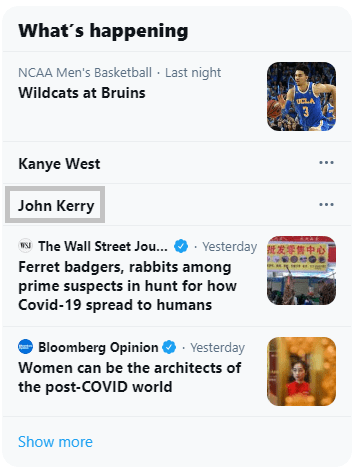
Trending is the concept where a topic currently being discussed on Twitter appears on the trends list, which is the collection of words stacked on a column to the lower right of your page(on desktop). Trends can be a word, a name, a hashtag, etc. For example, on Feb. 19th, this is what it looked like for me:
In the middle term, “John Kerry” for example, people on Twitter are referring to John Kerry talking about how “Earth only has 9 years to avert the worst consequences of the climate crisis.” As a result, his name is trending. This is what should be done and is the goal for Rep. Grace Meng’s H J Res 23 bill when it is voted on, as well as the hashtag #16ToVote. (An important thing to note is that stats for a trend don’t always show up, like how many posts are making it trend. Sometimes, this information does show up, like in the examples below. Other times, it shows up later, like in an hour or two.)
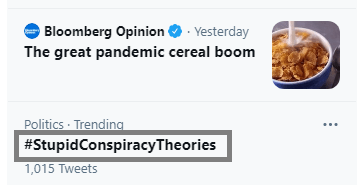
Some recent examples include trends I saw this weekend. Both aren’t serious trends, but are topics that people were discussing. On Saturday, Feb. 27th, a playful post called “#StupidConspiracyTheories” was trending. The posts was mostly filled with jokes or memes that Twitter does from time to time. It trended with only 1,015 Tweets.
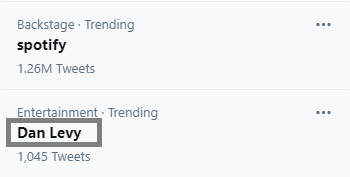
The next day, Sunday Feb 28, “Dan Levy” trended with 1,045 Tweets, mostly discussing his outfit at an awards show.
Before I saw this trend, I didn’t know who Dan Levy was. It was only after I clicked it that I found out why he was trending. This is what awareness is about- we use the same principle as a way to bring awareness to lowering the voting age.
In the examples above, the posts might not be serious, but they do bring attention to a cause or topic, no matter how silly it might be. You can also see it doesn’t require too many posts to trend. This is part of the Twitter system and how the trending process works- they don’t differentiate between political, celebrity, word or hashtag terms. Whatever gets the most posts “trends”. In order to get others to talk about lowering the voting age to 16, we who are supporters should openly talk about it.
I used the examples above because they’re the most recent, but you can find examples of this almost daily even if you don’t have a Twitter account to log in to. Just simply look up a random username, like @RepGraceMeng and you can easily see what’s trending. However, by logging into an account, you will get specific trend statistics, like what’s trending in the United States and sometimes, how many posts are attributed to that term. Remember, Twitter is a worldwide platform, so remember to change your settings to “United States” so you can see if anything we’re posting trends here. You can only do this if you have an account, so I recommend opening one for the most up to date information.
The trends system is something we take advantage to bring awareness for things to trend, like “#16ToVote” or “H J Res 23” or “Rep. Grace Meng”. Both hashtags, those with “#” and a word next to it(#StupidConspiracyTheories), as well as regular words/names without the “#” sign(John Kerry, Dan Levy) can trend, so we can use multiple things to trend, both hashtags and words or names, increasing the chances of bringing awareness to lowering the voting age. I’ll show more examples below.
How do we go about getting anything to trend? There are a few, easy strategies we can employ. They may look difficult at first, but when you get to the mechanics behind them, they’re not hard to do. As long as you follow the format rules, you can practically trend anything if enough people talk about it. For H J Res 23, for example, we just need a few people to post at the time the bill is being voted on. The closer to the exact time, the better. The more people closely follow the strategic guidelines, the more effective we can be towards supporting Rep. Meng’s bill.
Twitter posts
Ok. So if posts are needed to make something trend, what should you post on Twitter? There are some easy, general rules to follow that aren’t difficult. The topic we’re posting about should be a clue- “Rep. Grace Meng introduced H J Res 23 to lower the federal voting age to 16 nationwide. #16ToVote”. Just from this one statement, there’s plenty of material to work with.
You could write(tweet examplebelow):
“I support Rep. Meng’s H J Res 23 bill to lower the voting age to 16!”
You might even want to throw in a hashtag so other supporters using this guide can see what others have written:
“I support Rep. Meng’s H J Res 23 bill to lower the voting age to 16!#16ToVote“
In fact, adding in the hashtag #16ToVote should be mandatory- it adds to the number of people posting about it on Twitter’s trend counter, like in the #StupidConspiracyTheories example I used above. You might even want to use one of Rep. Meng’s Twitter handles so she might see it- @RepGraceMeng or @Grace4NY
Trending topics isn’t only available on Twitter- other forms of social media, like Facebook also have it. You can use these principles on other platforms, but it would be most effective on Twitter because of how the trends section is less cluttered than other apps, providing the least distractions to people online at that time you’re posting.
You might be asking “What’s our strategy going into this? When and how should we use these posts?” What kind of resources are needed to make this happen? I’ll briefly look into all of these. Here’s where we get into the technical specs of the trends system.
Strategy
In order for certain things to trend, you need plenty of those posts. Twitter “trends” things when there is a minimum post of 1,001 posts connected to a certain trend term. Think of it as measuring things in pounds(lbs.). Anything less that 16 oz. won’t register on the lbs. scale. However, you need a minimum to get above the threshold- anything above 16 oz. That’s the same principle behind the trending system. Less than a 1,000 posts would be in oz. territory while more than a 1,000 is the in the lbs. territory. We need to get to the latter.
How do you take advantage of the the Twitter trends system? The use of certain key words is important to deciding what to use. For example, if lowering the voting age is our goal, it is best to use terms familiar to us, strategically, so that it makes the idea of lowering the voting age to 16 more possible. Refer to the examples above. You can use an endless bank of non-hashtag words, i.e. 16; H J Res 23; a person’s name, like Grace Meng, Nancy Pelosi; etc. However, you can only use one hashtag per post, that word you attach “#” symbol to, because Twitter’s current algorithm system considers posts with more than one hashtag to be spam posts when done frequently. It can also be detected if you share posts that have nothing to do with the hashtag, like using #16ToVote and instead of a link to an article to lower the voting age to 16, you put a link to your personal website where you sell used items like electronics or something. Be careful of what you post, so make sure to double check links you copy onto a post. Here’s a more in depth article about this.
I’m not saying you can’t do this. There are uses for that, like archival purposes on issues that you want to easily find at some later point. However, for posting with time constraints in a short period of time, like within 2 hours, this isn’t feasible. Only one hashtag is permitted- marketers with large followings had previously took advantage of the system trying to sell products in a spamming manner, using two or more hashtags per post so that their items would appear in multiple categories. Twitter recently tried to curtail this by limiting posts to one hashtag for this purpose as well as making a business Twitter section in order to limit advertising in this manner as well as benefit from selling promoted ads that companies can pay for instead. Save multiple hashtag posts for other times, not during trending events.
Redundancy is key to trending things. It is necessary to say the same things several times in order for things to trend. I know this can be tiring, but it’s true. Look at the example below. All mean the same thing, but the same person can use it without it being interpreted as spam by the algorithm:
“I support @RepGraceMeng’s H J Res 23. Please lower the voting age to 16! #16ToVote“
“Please support @RepGraceMeng’s resolution to lower the voting age to 16, H J Res 23! #16ToVote“
“I agree that it is time to lower the voting age to 16- please show @RepGraceMeng you support H J Res 23 too! #16ToVote“
“H J Res 23 introduced by @RepGraceMengwill finally lower the voting age to 16. Please support it! #16ToVote“
“Let’s lower the voting age to 16. Please support H J Res 23 & @RepGraceMeng! #16ToVote“
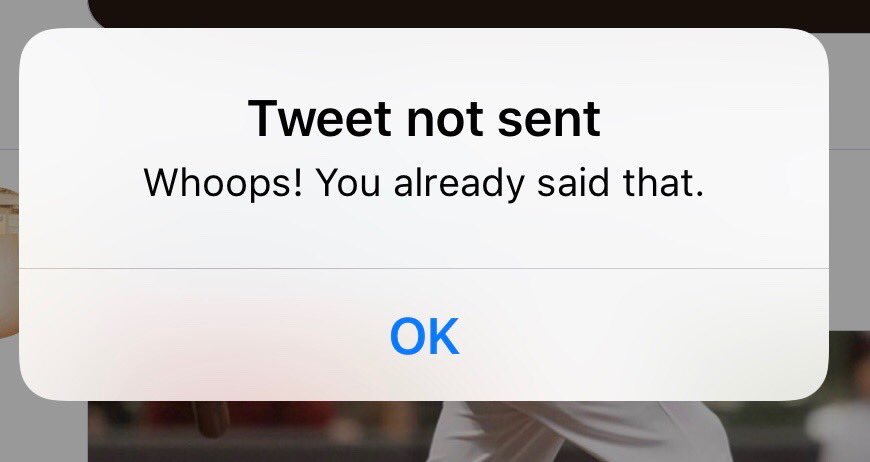
In the five examples above, they obviously mean more or less the same thing. They’re just five different ways to say it. It does sound repetitive, but it will go a long way in getting things to trend. This also helps you avoid a prompt (see below) if you copy and paste the same statement, since Twitter will tell you that you already posted this if you use the same exact thing word for word in a short period of time. This is why you have to use variations of it in order to be able to say the same thing to avoid the prompt- Twitter won’t let you post the same phrase more than once within the same day.
You can also mix things up by replacing Grace Meng’s name with co-sponsoring representatives of the bill. There are 17 co-sponsors for H J Res 23, meaning, including Rep. Meng, you have 18 ways to change up the examples above. You can also use @SpeakerPelosi or @TeamPelosi, Nancy Pelosi’s username handles on Twitter too. She’s a big supporting of lowering the voting age to 16, so she would probably be interested to see thousands of posts with #16ToVote in them. You can even use non-supporters, like @VP & @POTUS, who are of the same party as Speaker Pelosi and Reps Meng and Pressley.
Remember, when the bill goes up for discussion in the House, your representatives are the first group who will decide on the whether the bill advances to the senate. If you don’t know who your representative is, you can use this website to look them up. In this first round of voting, prioritize your posts towards your local representative. If you need additional ideas for posts, consider also reaching out to another representative near you if they’re not already a co-sponsor of H J Res 23.
So instead of like in the first example above where I wrote
“I support @RepGraceMeng’s H J Res 23. Please lower the voting age to 16! #16ToVote“,
you can now say
“I support @AyannaPressley’s sponsorship of H J Res 23. Please lower the voting age to 16! #16ToVote“.
“I support @AyannaPressley’s sponsorship of Rep Grace Meng’s H J Res 23 bill. Please lower the voting age to 16! #16ToVote“.
If you had only that one example to work with, by changing the person and message just a little, you can easily double the number of posts you can make. If we’re lucky, we might even get Grace Meng, Ayanna Pressley, H J Res 23 and others to trend in addition to #16ToVote to trend!
There are endless possibilities to getting something to trend, with near infinite variations of posts that you can use. Not only does using a person’s username, their “@“, alert them that we support their effort and want to make a difference, it gives you multiple variations to use as posts without getting the prompt that says you have already posted this. A person can easily make hundreds of posts with the suggestions above. You would have plenty of material to work with. You might even change a politician’s mind if they see the bill has plenty of support if they’re not already leaning towards approving it. Your combined posts not only inform people who are not aware of the bill, but it can even change the mind of those who are aware of it and will actually be voting for the bill- in the first phase, that would those in the House of Representatives.
Think of it as campaigning for your proposition or candidate of choose, except you don’t have to show voter ID, live in the same district, go anywhere or even know what your representative looks like. You can campaign from the comfort of home or anywhere for that matter. All you need is access to Twitter, follow the examples I’ve provided and be willing to post on the day the bill is discussed for a minimum of two hours. That’s all there is to it.
The #16ToVote Hashtag
However, because you can only use one hashtag per post, #16ToVote would likely trend on Twitter if enough posts can be Tweeted from Twitter in a short amount of time. From what I’ve learned in my insider’s training camp at Twitter few years ago, this is around a period of about 2 hours. On slower days, like a weekday, trends can stay up even longer. This is important if you want to reach a wide audience- people who are online at that time, people who are watching the bill like us and later, people coming home from work or are otherwise not able to access Twitter at that time. They key is getting #16ToVote to trend. So if we have an exact date for when voting for H J Res 23 happens, we can coordinate with allies regardless of timezone. If you support lowering the voting age even just a little and want to help, there will be a way to do it!
So for example, if it is being voted on at 12 noon on March 17th, 2021, people in the eastern timezone can start posting around 11am- 1pm, so that the voting occurs in the middle of the voting for it. People on the west coast can join in at 8am until 10am PST. Even though our local times may be different, we’re effectively posting at the same time span. People in Mountain and Central times can also adjust posting time accordingly. The closer we can get an exact time for when the bill will be voted on, the more precisely we can coordinate and give exact times when you should post at your respective timezone.
If we have other national allies who want to help, they can synchronize to our timezone once we know what area they are in, so it’s not just people in the United States who can help us “Tweetstorm”. We can do likewise for other organizations when they have similar events or legislation in their parts of the world. We might even want to reach out and coordinate with them to see if they’d be willing to help out on this if we can help out if they have similar bills being looked at or events they are having to promote a cause. We just have to coordinate at the right times for our events and get details on them.
This is why if someone is willing to help out, it is also important they reach out to their networks, inside and outside their organization, for additional people to help make posts and state their timezone. It is understandable that organizations will have varying levels of investment in lowering the voting age. Some see it as their number one goal. Others see it as one of many. Others just loosely support it. However, more people posting means less posting per person and the more information we have on allies, the better we can coordinate and get a headcount to see if it’s possible.
Tweetstorming
You can use this example Tweetstorm kit for reference if you need guidelines, but obviously a new kit will have to be drafted for H J Res 23 or any other different event. The principles will be the same; only the info for the event and content for posts would actually change. There is no current info for place or time at this moment for H J Res, so right now, this works in our favor. Things like the example above and hashtag rules will stay the same, though. I keep an eye for specific info from various sources, so I’ll be sure to update my network if I hear anything. Likewise, if you don’t hear anything from me, my email is below also, so reach out to me if you think anything is worth mentioning. I’ll be glad to talk to any supporter regardless of your organization affiliation.
Another key to getting something to trend is how large your group is and how many people can devote to posting. One person can come up with hundreds of posts, but it would be impossible to post them all in a short period of time. Even if a person made a post once every minute for a two hour span, the most that person could write is 120 posts- not nearly enough to trend something. This is obviously not a one-person operation or even a one organization one for that matter- it’s a team effort. For a bill that has nationwide effects, I encourage all groups to coordinate together. This bill, if passed, doesn’t affect just on city or state, it affects all potential voters in the United States.
The bigger our group is, the higher the chance of success for something to trend. It goes with the adage “More people means less work” or “Many hands make light work”. How does it work for the particular principle for trending on Twitter? Here’s an example:
1 person posting ~ = 1,001 posts needed
2 people posting~ = 500 posts needed per person.
5 people posting~ = 200 posts per person
10 people posting~= 100 posts per person
20 people posting~= 50 posts per person
etc.
As you can see, the more people involved in Tweetstorming, the more likely a post will trend & less posts are required per person to pass the “Trending quota.” Of course, you don’t have to follow the exact posting recipe; if 10 people on our team were Tweetstorming, one person might post 97 posts, while another might do 103. Now, imagine that 100 people volunteered. You’d roughly need just 10 posts per person. That’s not hard considering if the average person posted once an hour in a 24-hour period while they were awake, assuming they sleep 8 hours a day, they could easily make 16 posts a day talking about random things, like what they ate, the weather, a meme they saw, something in the news, etc.. Here, we would only need you to post for a couple of hours. You would be free to enjoy the rest of your day.
How do we know who does what and how many posts are made? We really won’t know unless we go to their profile and start counting. Obviously, no one will have the time or resources to do this in the middle of a Tweetstorm, so we’re just going to have to operate on the honor’s system. I advise aiming for 5 to 10 additional posts to make up for what your team isn’t able to cover. If you aim to make 100 posts on that day, try to go for 105 to 110. I don’t doubt, with the number of organizations that have expressed support for lowering the voting age to 16, there are easily thousands in membership among the many groups.
Think about your immediate circle. What about chapters? Consider reaching out to organizations that have expressed lowering the voting age. If even 500 people posted 2 posts while H J Res 23 is being voted on, you could easily trend something related to it within minutes. I think most people who are supportive of something like this that has nationwide effects would be interested in playing a part in making it happen. This is why it is crucial to have as many people on board as possible- the more people posting on its behalf, not only would you need less people to make it trend, but the faster it would also start trending.
This type of posting not only means that a few people would be needed in putting up posts that conform to Twitter’s exact guidelines in order to be counted(rules), but those persons would also need to devote a specific portion of their time for the day when posting is necessary( the schedule). There is still no exact date on when H J Res 23 will be up for a vote- yet. As you can see, this would require some really devoted people/organizations because this is impossible to do with only a few people(coordination).
With larger groups like sports or celebrity fans, this level of planning is not needed. If ten thousand posts are randomly generated by those fans, with half (5,000) not being counted because it’s not formatted right, but the other half are, then you can see it will still trend. Posts can easily go up to the tens of thousands. However, for smaller groups of less than a hundred, planning is not only necessary but essential to making this plan succeed. There’s very little room for error when your group is small. However, I’m confident with the size our network and allies, we can close that gap and allow for some margin of error.
I am hoping, for those who are reading, regardless of your organizational membership, your follower count size or how new you are to empowering youth, that you can reach out to as many people as possible in your network and outside your orbit. I think far too many bills to advance youth rights don’t succeed because many of its supporters don’t coordinate on a campaign to help bring awareness and find supporters for them. Many people don’t know or even hear about it unless it’s a passing reference in some paper that says the bill failed. What makes this bill different is that it concerns federal legislation, not one city or state- this enfranchises all working, income taxpaying youth in the United States. So for all organizations working towards this goal, regardless of your region, this should be of some interest to you. I’m assuming for the most part, we’re all based within the United States. As a result, we should similarly be “united” in our efforts to lower the voting age and enfranchise more voters across the nation.
The objective this time, given the favorable political environment that we have in terms of politicians in office who support this as well a high dependence on electronic platforms like Twitter during the pandemic, is help bring attention to H J Res 23 and encourage its passage. This is a potentially strong and opportune time to make this happen. I have watched numerous events go on in the last year since the pandemic began, for various issues ranging from climate activism to voter rights to events/protests and haven’t seen any preferred hashtags trend, despite various groups making their own Tweetstorm/social media kits, while posts of less importance have easily trended. What one wears to an award show or whatever goofy meme someone can think of doesn’t have as much importance as enfranchising voter who have contributed to their local economies, paid taxes on their income, lived with the tragedy of a nationwide pandemic while balancing decisions made on their behalf on what direction their schooling will take during this difficult time. I believe we can change this by advocating for lowering the voting age specifically if we have a guide to follow and coordinate with those who want to help.
This is why I have given much importance on this topic as well as shared my knowledge with those are willing to listen and act on it, and call on all organizations who can make a difference to band together. This is a big issue that goes beyond one person or organization. None of us can do this alone. I cannot do this alone. You who are reading can’t, and it’s probably safe to say anyone organization in this fight can’t do it alone. We share more or less the same ideals- giving a voice to those that don’t have one, so that they can make a difference in a world that they will inherit tomorrow on issues that affect them today. We can and will make a difference if we work together. Let’s work on a plan and have faith in it.
Summary
There isn’t much else to it. I’ve covered most of the main parts here. I will throw in an additional guide prior to discussion for H J res 23 when we get an exact date and time for it. The above material should be a starting point as well as provide rational for why teamwork is essential for this endeavor. To summarize, whether or not something trends with smaller groups and their allies will depend on three important factors:
1) The ability to adhere to the posting guidelines as closely as possible (following platform format rules so your post counts and it trends).
2) The time and manner when the Tweets are posted (the schedule so that it can trend when most of us are posting).
3) How efficient we and our allies can coordinate with the first two (planning together and coordinating with each other on this strategy).
All three elements are essential. It won’t work unless all three are done together. Think of these simplified examples: If we can put plenty of posts and get the timing right, but don’t format the posts correctly, nothing will trend. If we make plenty of posts, do the formatting correctly but don’t post within a strategic time frame, it won’t trend either. Lastly, if people make posts and Tweet them out at the right time, but there’s only a few of us able to do it, nothing will trend either. You need a dedicated team, willing to put posts that will count and are formatted correctly and be willing to post around the time frame that H J Res 23 goes up for discussion.
Closing
Trending isn’t about being put on a pedestal and telling people what we want. We already support lowering the voting age to 16. I suspect people in office who support it already know many organizations out there support it, but they don’t always see that support. The goal of trending is to let the people unaware of issues like lowering the voting age to 16 or H J Res 23 to be made more aware of them. At the same time, this also makes those aware who support the bill know we are appreciative of their efforts and are doing our part.
Think of it like a virtual protest- people don’t gather in large crowds waving signs in hopes of not getting noticed. Quite the opposite. They want their issues heard, maybe even taken up by their representatives or noticed by a reporter. Tweeting with a purpose with the goal of trending in mind is just like this- we trying to be heard so that others can be heard. What good is campaigning for something if we don’t work on a strategy to make it a success? We need a blueprint for it and I have provided one as far as an online strategy goes. Feel free to pass it around and consider it free advice.
By trending something on Twitter, you can do away with worrying about phonebanking, sending emails or talking to a person face to face to inform them about these issues or H J Res 23. We can use a free resource at our disposal to reach out to as many people as possible as well as let our allies know, both organizations and those in office, that we want to make #16ToVote happen. I think we can make this happen if we work just a little bit more with our other allies around the globe.
If you found any of this information enlightening, then do please share it. I didn’t write this for my own benefit- it’s to help your particular organization’s goals if you want to do some online campaigning for just about any issue. Additionally, if you have any questions on how to use this, need clarification on anything and/or want to help, please reach out to me and I’ll do what I can. Thanks and good luck!
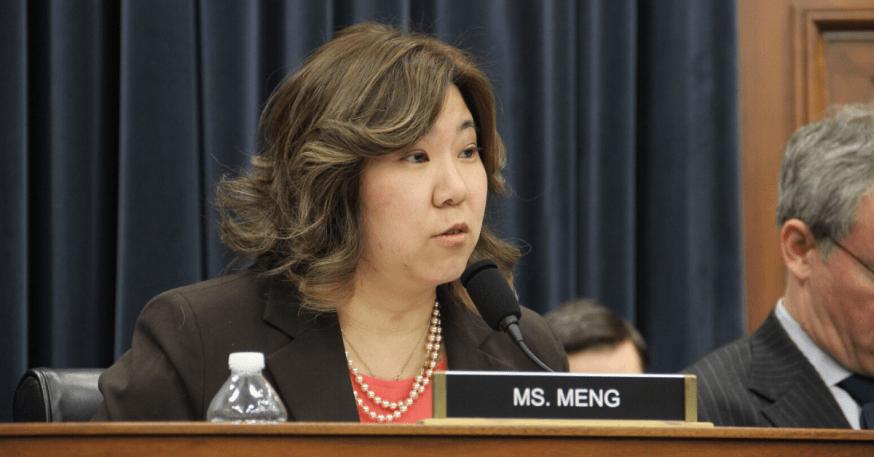
Representative Grace Meng recently at a Homeland Security Appropriations bill hearing. Rep. Meng is one of several supporters of lowering the voting age to 16. [photo source]
Last month’s blog post talked about taking advantage of the current favorable political climate in order to make gains towards extending youth suffrage. Today’s blog will talk about how this will be even more important in the next few weeks.
Rep. Grace Meng recently introduced legislation that will do just that- and we need to support it as much as possible. H J Res 23 was released nearly two years after Ayanna Pressley released a similar bill. Although it didn’t pass, it did get bipartisan support in a very challenging political climate- which is astonishing. Now consider this bill where favorable supporters control virtually all levels of government. Even more so with bipartisan agreement on recent issues. There is a high chance of success if we can also launch an effective social media campaign in support of this.
Politicians will largely have an impact on whether on not this bill will be successful. However, that does not mean we as supporters can’t do anything and can only watch from the sidelines. We need to act on this as well, and there’s a plan for it. I call on all youth suffragists & supporters to consider helping out with a new media campaign regarding this that I am working on with several supporters. Whether Rep. Meng’s bill passes this time around or ends up like Rep. Pressley’s bill will depend largely on what we, the supporters, do in the next few weeks while it is being voted on.
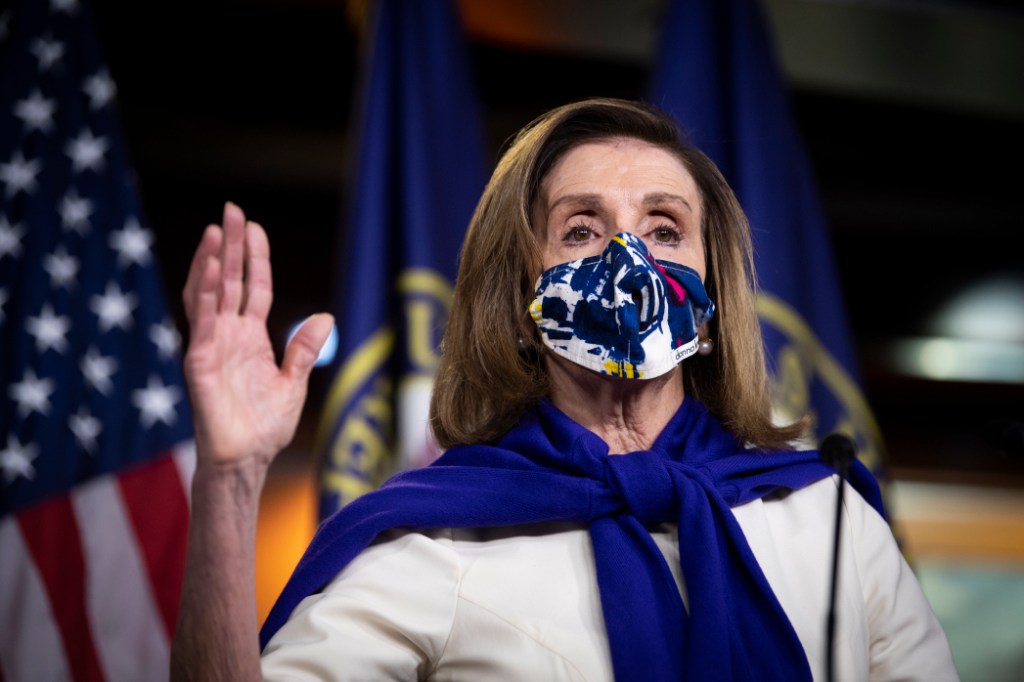
Nancy Pelosi once again takes the Speaker of the House Office oath after her recent narrow victory. This might also be her last term as Speaker of the House as well.
It’s a new year again, which means another year to keep fighting for youth rights and continued enfranchisement.
Even with a new calendar year, there are still challenges that need to be overcome. We’re still in the middle of the COVID-19 pandemic and have only started to begin addressing the issue. It will likely be another year or even more before it will be safe to be able to travel again.
At the same time, we also have a new administration that will be able to enact policy that will hopefully see the enfranchisement of more youth. In one town hall almost two years ago, then presidential candidate and now future Vice President Kamala Harris addressed the idea of lowering the voting age to 16, saying that it should be a discussion to be looked at and have. This town hall occurred just one month after Ayanna Pressley had introduced a bill to the House that failed to pass but still received bipartisan support.
In other relevant news, Nancy Pelosi also narrowly maintains her role as Speaker of the House. However, this may just be her last stint at the position, meaning that unless the next Speaker of the House is also suffrage-friendly towards youth, our working timetable to get anything appreciably done might be in the next two years- this year and next year.
As a supporter of lowering the voting age and enfranchising more youth, both in the United States and elsewhere, I call on all allies of any form of suffrage to take advantage of this window and consider how we can work together too to make sure that we can make some gains within the next two years.
What the allies of youth suffrage might accomplish between now and the end of next year might determine whether or not we will lower the voting age any time soon or have to wait for some of our youngest supporters to get into office themselves many years down the road before we can get another decent opportunity to do so again.
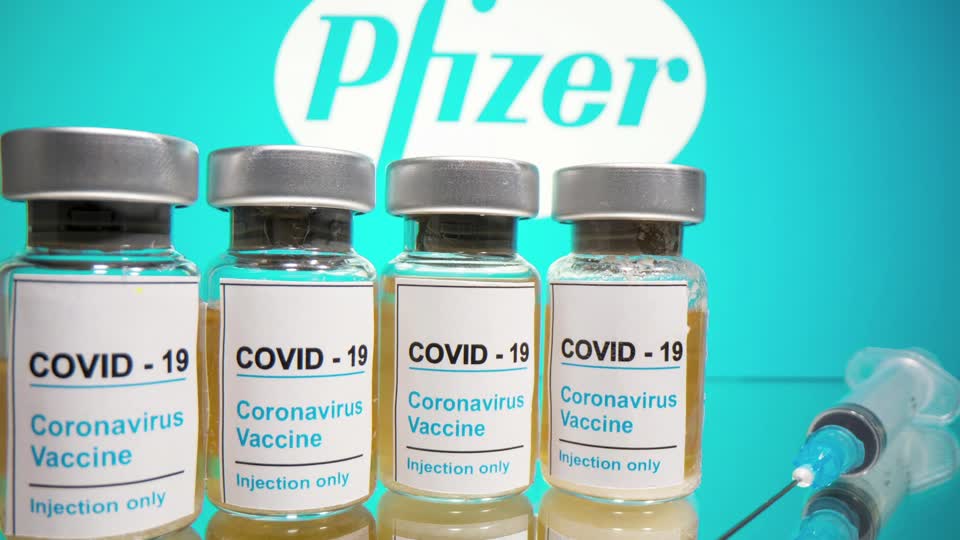
A “shot” of Pfizer COVID-19 vaccine bottles with the Pfizer logo in the background. The Pfizer vaccine has recently been approved for those 16 and older to combat the COVID-19 pandemic.
Today’s the last 16th of 2020 and there’s some good news in regards to the COVID-19 pandemic and possibly, those supporting lowering the voting age to 16.
A few days ago, at the end of last week, Pfizer’s COVID-19 vaccine was approved. Not only do we have a medical tool now available to combat the pandemic, but we’re also a little closer to emerging from local and state lockdowns.
Obviously, it will take some time before we’re in the clear and it will also take a little longer before a sizable number of people are protected from COVID-19. There’s still so much we don’t know about the vaccine- such as do you need to get a shot if you’ve already had COVID-19, does it prevent transmission to others if you happen to get it but have already been inoculated by a vaccine or when less vulnerable populations like healthy people who are not emergency responders will have access to it. Everything in due time.
Not only has the possibility of a vaccine brought hope for those afraid of the effects of COVID-19 on their own personal health, but it also has brought hope for supporters of youth rights, specifically those working to lower the voting age.
How does this help with the overall movement? It’s putting the movement front and center again while lives are being saved. Not only has the vaccine included the disfranchised age, but this opens up dialogue once more politically.
Youth supporters advocating for advancing expanded rights for youth like voting, regardless of their organization affiliation, should try to incorporate this in their own dialogue and think about how we can keep this in the mainstream.
By Pfizer’s vaccine approval, we are showing the importance of youth inclusion in things like vaccine studies and fighting pandemics. This is even more so if they’re given a vote- the pandemic affects young people, albeit in different ways, than old people. Nonetheless, they’re still affected. We should try to find more ways to include them as we fight the pandemic now, but also going forward into 2020.
The Golden Gate Bridge in the city of San Francisco. This city has quite a bit of meaning to me personally as well as the #16ToVote Movement. In addition to being Twitter’s HQ where I worked for some time, it’s also the district that Speaker of the House, Nancy Pelosi represents. Pelosi is by far the biggest, but not the only, supporter of lowering the voting age to 16. It’s also the city I completed my nationwide walk in 2015 after walking for nearly four months in order to promote lowering the voting age (I will get to that more later). It’s also where two efforts to lower the voting age have been attempted, most recently being this year. Both attempts have failed so far. Today’s blog will offer commentary as to why I believe this is a failure of collaboration among the different groups advocating for it. & what we need to do if any future attempts are to be successful.
I don’t usually write much on these blogs- readership is usually low. Perhaps you, the reader, can help with this in the future. But for the sake of the movement, & today being the 16th, when I always post one blog in support of lowering the voting age like I have for more than 5 years, and I’m feeling a little chatty today, you’re going to read all my thoughts on the matter, both the good & the bad, on lowering the voting age to 16. While I won’t be abandoning the work on lowering the voting age, I am rather disappointed at certain groups and will be discussing this in a good portion of today’s blog. First off, let’s start about my work, as some readers of today’s blog may not be familiar with me, so take this as sort of an introductory post as well. If you do read one blog post today or one I’ve ever written, make it this one.
So in case you may not be aware, I’m a supporter of lowering the voting age to 16. I’ve been a supporter for more than a decade, ever since I heard one area in Switzerland had lowered it’s voting age sometime in 2006. It was around that time I learned about an organization, NYRA(National Youth Rights Association), and their work. At the time, lowering the voting age to 16 wasn’t really a popular idea or movement. Things like marriage equality/same gender unions itself was in it’s infancy. Although I wanted to join NYRA, being a Californian, the distance to HQ(Washington D.C. at the time, I believe) was intimidating. I was also still a student going to school, so I didn’t have the luxury of traveling. The east coast was just too far away. Additionally, I grew up in a not politically conservative but lifestyle-conservative home, so supporting “fringe” ideas like lowering the voting age would probably not be an easy thing to do, given how young I was at the time and the kinds of values my family held.
Fast forward to the early 2010’s. I was now in college and had seen that NYRA was growing as an organization. They’ve been really active in Maryland as well and I think they tried a few times in Maryland to lower the voting age to 16. We also had something similar a few years before in California, but again, the concept of lowering the voting age was new at the time, so support for it wasn’t as big as compared to today. I was inspired and encouraged by NYRA and other groups working on enfranchising taxpaying youth(because I had my first job at 16 and paid taxes on it like any taxpaying youth), especially after their initial victory in Takoma Park, Maryland in 2013. I saw what I could do to help, but even at that time, finding help in as liberal a state as California was still a difficult endeavor, so I stayed informed but was limited on what I could do.
Fast forward just a few years- 2014-2015-ish. I had joined a service club called Kiwanis(similar to Lions, Rotary, etc.) after graduating college. I’m a big supporter of volunteering and wanted to help my community. I also learned that Kiwanis was fundraising for a charity they were working on with UnicefUSA(the people who do trick-or-treating with UNICEF each year). I also learned that Kiwanis, internationally, was going to celebrate it’s 100th anniversary in 2015. Based on all the information I had at the time, I decided I was going to walk across the United States. One of those reasons was because I also wanted to open dialogue for lowering the voting age to 16 in addition to raising money for the said charity(info can found here). A had read a few people had done something similar around that time, so I figured I would do the same.
For nearly four difficult months, from May to September of 2015, I trekked, literally, from sea to shining sea, by foot, to get from New York City, NY to San Francisco, CA. I lived off mostly donations, because I was not able to save much prior to it and depended on the generosity of clubs I traveled to and strangers to help me get by at many points of my travels. During that time, I also endured weather, isolation/loneliness, bug bites & uncertainty, in order to promote lowering the voting age and raise money for Kiwanis/UnicefUSA.
On the eve of Labor Day weekend 2015, I had completed my nearly 4,000 mile trek, reaching San Francisco just a week after September(route wasn’t exactly east to west and I opted for a longer route). Shortly thereafter, I not only learned that I became the largest fundraising individual of the charity, but I also brought more attention to lowering the voting age than I thought- Speaker Nancy Pelosi apparently first advocated for lowering the voting age to 16 during my walk, in August of 2015. That was the first time it had national coverage and had an endorsing politician to do so. Like I mentioned earlier, we’ve had smaller local stuff in California, like Takoma Park & Hyattsville in Maryland did, but nothing of this magnitude before. I’d like to think in some way, in some brief instant, Speaker Pelosi saw a story about a person walking across the United States and was compelled to make that statement. I want to believe I had played some role in that happening. Other groups also emerged around this time that advocated for lowering the voting age, which was something I hadn’t expected. I was glad we were growing.
Of course, just because someone says something, it doesn’t mean it will happen. Even with the Speaker of the House advocating for a lowered voting age, it wouldn’t automatically happen. I wasn’t expecting this either. There’s work to be involved, so I was always looking for new ways to make lowering the voting age to 16 more likely to happen. I decided I would reach out to some of the different groups that had emerged.
After my walk, I was approached by a few other places as well. Twitter for instance was one notable group. I took up their offer because of how close they were to where I lived & was able to work with them for a few years. Not as an employee, but as an insider of sorts, getting a preview of what’s happening on the platform while also getting a heads up on future innovations(much of what you see today was stuff I previewed way back then, but wasn’t released until recently- implementation can take time…). Although I no longer work with Twitter to this extent, I do value my time there and learned plenty, most importantly the way things “trended” on the platform. Another reason I took the offer was because I was also interested in helping promote lowering the voting age through the hashtag “#16ToVote”, which NYRA has actually been doing for many years, and other movements had taken up. Hence, the hashtag of choice when I made Tweetstorm kits for events about lowering the voting age to 16, as well as the namesake of this blog and one of my Twitter accounts that I use to promote the movement. However, I had a less than pleasant experience, from my perspective, from what I thought would be one of the larger supporters of the movement and one that I thought would have been more helpful than not.
After my walk across the U.S., I noticed groups began emerging around the idea of lowering the voting age to 16. There were a few here and there and some were larger than others. Seeing how I was just fresh from a nationwide walk to promote the idea, I approached one organization. I was then disappointed that said organization refused to collaborate with me and didn’t want my “help”. The following year was when San Francisco first started calling for lowering the voting age through Prop. F. We all know how that resulted- it was close, but it failed.
Two years had passed. It was now 2018. First, the tragedy in Las Vegas happened just a few months prior, in late 2017. Then the unfortunate incident at Parkland, Florida happened just a few months later, in February. That year saw a blue political wave, as people became fed up with students having to risk life & limb for an education, as well as a need for better regulation on firearms. The House saw a large growth of freshmen Democrats. Even one of the most conspicuous of the Parkland students affected by the tragedy, David Hogg, who is often seen as one of the faces of the tragedy and main spokespersons, supported lowering the voting age to 16. In fact, he’s done so numerous times as well. Even many of Hogg’s immediate circle from Parkland also support the idea. Not only do youths not have a say in where their tax dollars are spent, but they don’t even have a say in their own safety while at school. Unless you’re lucky enough to be in Berkeley, CA and a few other places where school board elections have lowered the voting age to 16, you won’t be able to have much of a say in your local school board. This is even more critical due to COVID-19, which I won’t go into here. Just know youth are also suffering as well- through health problems of their own, loss of work, school issues because of the pandemic, & unfortunately, even family tragedy as you read this. But they don’t have a vote on these and other issues that are affecting them today.
Last year marked a change or shift in the national dialogue. Not only had Speaker Pelosi once again called for lowering the voting age to 16 a second time, but one of the “Squad’s” “Freshman Four”, Ayanna Pressley, also introduced legislation that would have lowered the voting age to 16 on a national scale, a consequence of the “Blue Wave”. Obviously, that didn’t pass, but it did get bi-partisan support- even a Republican voted in favor of it. This shows the idea isn’t a partisan thing, but that we want all taxpaying youths who contribute to their local and national economy to have a vote. Now imagine if it had the support of all the organizations, representatives and people reading this right now. Now imagine if after reading this we actually worked together instead of working in our own separate worlds. This movement is far bigger than any one of us and we’re all not working in a vacuum- what each of us contributes helps the general movement, whatever resource that is. At this time, it’s still lacking & we need to collaborate more.
With the change in focus on a more collaborative endeavor, as well as renewed calls by Pelosi and new voices like Ayanna Pressley, I sought to once again try to see if I could unite all the different groups working to lower the voting age to 16. By now, there were even more groups than 2015, but obviously the big names were still priority contacts. I went back knocking on a few online doors to see if I would get a different response than the one I received in 2015/2016. Sad to say, nothing had changed. This was in late 2019, long before the effects of COVID-19. Now, we’re at where we were at with Prop. G, much like Prop. F four years ago, it has once again failed. Should we wait for “Prop. H”(assuming if that’s what it’s to be called based on the nomenclature pattern, if there even is going to be one) the next time around, whenever that may be? Should we all work in our own separate little bubble and hope that we don’t have to collaborate with others that could potentially connect us with additional supporters? Does anyone believe I will “knock” a third time to reach out to reach out to the same people, to the same organization that refuses to work with me(see pic below)? For the latter, this will depend on how those who are currently working on the movement decide to move forward. I cannot change people’s minds if they don’t decide to listen first. I would answer “No” to the above questions I posed. I hope you will too.
In closing, I want to make a few simple, yet understandable statements that you can understand no matter where you are in the movement, from simple supporter like myself, to the most well-connected president/CEO/etc. of an organization supporting it:
First, I’m not a know-it-all. I don’t claim to be nor will I ever claim to be one. I learn something new each day. I want to make very clear that I don’t consider my contributions any superior to any group or movement reading this. However, at the same time, I don’t want to be knocked off & brushed off as if I know nothing about the movement and just an insignificant contributor- not unless you’ve literally walked close to 4,000 miles in my shoes or have social media technical know-how to make a difference in a movement that you only just joined recently. I may not be the oldest supporter of the movement, nor the one who’s supported it the longest, but I’ve been around for quite a while to know what works & what doesn’t.
Second, as the current model stands, which is to work in our own separate little corners, I am here to tell you that it is not sustainable- wehave to work together. This statement is obviously not aimed at all movements. Some are very collaborative and helpful, and I’ve gotten to know many members from some of these groups. They know who they are. But some collaboration, or at the very least, a listening ear, would be helpful. We might not always agree on everything, but we can share vital resources with one another that will help the general movement.
In both of the points I made above, working together is the solution. As a general movement, yes, we are growing. But, also as a growing movement, we are also not collaborating all that well. Look at the example for climate change and how big their movement is, as well as the one for March For Our Lives a few years ago. An even more recent example is the Black Lives Matter Movement(BLM). That is what I want the #16ToVote movement to reach. That’s just not happening at our current level, and I believe not collaborating in a meaningful way with a clear, cohesive strategy has been detrimental to the success of lowering the voting age in areas open to it. Again, I have ideas that might be useful, but if you’re not going to hear me out, it helps no one.
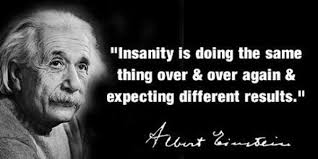
I’m willing to sit down and talk with whoever is willing to listen. I will listen to you as well and hear what you have to say, but I’ll be least likely to listen if you brush me off if I promote trying to work together. I cannot reach out to you if you’re not willing to listen nor collaborate. I’m not here to cause trouble or make fun of your strategy or way of doing things. I’m here to see how I can help your movement and supplement it. Want to help? Email me; call me; talk to me. Strategize & communicate! I have various ideas on how we can make it happen. Let’s reach an understanding. I’m a pretty easy person to reach. I may not always get back to you right away, but barring a technical issue or some other unforeseen event, I’m more likely to get back to you if it’s an important matter. But don’t shut me down without having to hear what I have to say first or belittle my thoughts. Obviously, things don’t happen overnight. Yeah, I get that. I think most of us do. Refusing to collaborate among an already small group of supporters scattered throughout the U.S. is not understandable. It’s not smart- it’s just insane! As a great mind once said:
“Insanity is doing the same thing over & over again & expecting different results.”
-Albert Einstein
As Einstein said above, I’m not insane but a rational person, with rational, strategic approaches and ideas that may benefit movements that support lowering the voting age. I’m also a big believer in second chances when it comes to reaching out to others, even those that have turned me down the first time. However, not so much so in third ones. & if you finally do reach out to me after that, there should be a compelling reason why.
I’m not asking anyone to join or leave an organization- having a diverse mix of organizations focused on an issue here or there is fine. In fact, it’s great because it shows the various reasons why we have a common goal- there are many issues that could used additional enfranchised voices. But we have vast reserves of untapped potential and resources that aren’t being used effectively. There has to be some element of collaboration if there is any hope for enfranchising more voters, especially 16-year old voters who don’t have a vote. We need to stop working in our own little separate corners today & work together by reaching out to other movements & supporters, no matter how small, to enfranchise the future leaders of tomorrow– who are depending on us to get our acts together. Help me help you. Don’t disappoint the next leaders of democracy!