A view of the International Space Station as it orbits the Earth. It is home to a multi-national congregation of astronauts from across the world who now call space their second home(Photo courtesy of NASA).
Last month, I had written about the eclipse around the time I was forming a panel for the Frontiers of Democracy conference in which I had made a post on Twitter that was liked by Rep. Grace Meng of New York. This month, we’re still staying in space to continue talking about more down to Earth matters.
If you’ve been following the recent news on the stranded astronauts on the International Space Station, you may have heard that the astronauts, who had planned to return to Earth after a supposedly one-week mission aboard, have now found themselves needing to stay in space for more than half a year while the issues with their vehicle back to Earth are sorted out. The earliest return window for the astronauts will be early next year. That’s if things go according to plan, with no additional delays that can prolong their stay potentially popping up between now & then.
This year marks the 11th year since Takoma Park in Maryland became the first city that lowered the voting age to 16. Since then, half a dozen other cities have joined that exclusive list, including a city in Vermont, Brattleboro. If you add in states with cities that have lowered school board voting ages, like Berkeley & Oakland in California, as well as Newark in New Jersey, then you have even more youth that have been enfranchised than in the past. More efforts are continuing to expand that list of enfranchised cities, for both local general elections but as well as school board elections.
Even with a lowered voting age in Takoma Park in 2013, if one were to say that lowering the voting age to 16 were possible in the United States around that time, most would say it were impossible, if not downright hard. Other cities, now with Vermont as a state on that list, that is becoming less & less impossible of a dream. If astronauts can vote from space(since 1997), then lowering the voting age to 16 shouldn’t be either.
A photo of the recent total solar eclipse from April of this year. Predicting efforts to lower the voting age just might be more easier thanks to the recent momentum & victories the concept has had in other global democracies as well as local efforts here in the United States.
Some opportunities come once in a lifetime, while others may come a few times. Others come with frequencies somewhere in between the two. Depending on what that opportunity is, for some it may come often while for others it might not come often enough. For lowering the voting age, 2024 is that once-in-a-lifetime opportunity.
Earlier this year on April 8th, we saw the first total solar eclipse to happen in North America since 2017. While seven years may not seem like a very long time, when you consider that the next one won’t happen until August 2044, twenty years from now. Although total solar eclipses do come with some frequency, the path they take and their regularity aren’t predictable- they don’t come in predictable time frames(every 5 years, or 10 years etc). So in some ways, you can predict that they will happen eventually but, without the precise calculations scientific experts like astronomers, mathematicians and other scientists, you can’t pinpoint the next exact time it will occur. Thankfully, we have experts who’ve already figured that out down to a science. However, without those experts, we wouldn’t know when the next one will happen.
How does this this compare to the voting age movement? There are many parallels you can use to compare the two. For example, Takoma Park in Maryland became the first city to lower the voting age to 16 back in 2013. As of last summer, 2023, we now have seven cities spanning across two different states(Maryland & Vermont). If you include cities that have lowered the voting age for school board elections, then you have four(California & New Jersey are on that list). If you include cities that have some sort of movement towards lowering the voting age of any kind, then you have many, many more. Those are just local efforts, not looking at House Joint Resolution 16, the congressional bill to lower the national federal voting age, which is the focus of this month’s blog post, but also a uniting point for many supporters who are working tirelessly around the country to empower their local youth.
The voting age movement is by no means new. However, we have many great people engaged in the effort that are not organized into “scientific experts” like they are with the eclipse phenomenon mentioned above. Many of us work in volunteer roles, some with organizations & some alone, in addition to our everyday jobs & family responsibilities. But we’re united in our efforts to bring more awareness of the cause no matter where we’re located.
Several days after this year’s total solar eclipse, I wrote both a Twitter post & a monthly entry on my Vote 16 blog, something I’ve been working on for more than a decade. I write a post each month on any update connected to lowering the voting age, even covering international stories if relevant. However, I make the blog accessible for people who don’t already subscribe by also making an announcement on Twitter. The latter helps because people can not only look up the #16ToVote hashtag where I’ve posted previous editions of the blog, but I can also tag relevant people to them that I can’t tag on the blog itself. April’s edition just happens to have relevant info to several users, one of which being Rep. Grace Meng of New York.
I’ve written these entries with regularity for nearly a decade, and have tagged Rep. Grace Meng in some of those posts in recent years, including previous iterations of HJR 16, such as HJR 23 that was written in 2021, which was introduced in Congress during the height of the COVID pandemic but did not receive a formal vote during that congressional term. Congress was not only preoccupied with the pandemic, but the aftermath of January 6th, something that not only impacted all members of Congress & the Sentate, but also Rep. Meng personally. Many of her colleagues were the same way.
In all the years I’ve tagged Rep. Meng on these Twitter posts, not a single time has Meng interacted with any of these posts. Not once. Until April of this year, when she liked this post that I’ve shared around.
Due to recent changes at Twitter, besides wanting to be referred to as X, likes have now become private, so only the original poster is able to see who has liked their post, even if others are logged in & follow the account. However, I’ve found a workaround for it by making a short video showing who has liked the post. I’ve posted the video on Veoh, so even if you don’t use Twitter, you can see the video of the post I’m referring to. Even those with an account who are not logged in can’t see it, and as of June even those with an account couldn’t see it while logged in. Now, anyone can see it, though you still need a Twitter account to interact with the actual post.
The fact that with have a national bill, HJR 16, and that the very author of that very bill in Congress, Rep. Meng, liked my Tweet, shows that we have momentum on our side, and the people behind these efforts to empower young people in government leadership are aware of our own work around this. You can refer to my previous posts in the last year on my blog as to why we have the momentum- my posts have covered many efforts around the U.S. as well as international news, so much of these pieces of documentation point to the momentum being on our side. I think we can make a very good case on lowering the voting age in 2024, rather than wait at some time in the future, like the next total solar eclipse. One can say, astronomically & figuratively speaking, that “The stars are aligning” in regards to the movement to lower the voting age. That does not mean it will happen automatically nor will it happen if we do not work together to make it happen.
While enthusiasm & momentum can’t be measured like calculating eclipse schedules through mathematical models & science, I can guarantee as an activist who has worked with others over the years to lower the voting age in local & national efforts that 2024 is the year we can generate change– if fellow supporters can get behind the planned advocacy day we’re working on & work together as one to call for a lower age in both local as well as national elections. We can make a reality that is only realized in only a few places in the country & something that many supporters like me have worked on for so many years happen.
I believe lowering the voting age to 16 can very well happen- in 2024. But I also know I cannot do this alone. No one can do this alone, whether a person or organization. It will take a village to do so- a village of voting age supporters, generating enough awareness so that others can also support the issue. This is why would like to ask for your help to make that happen.
I encourage all supporters, regardless of where you’re located, to get in touch with me so that we can bring more awareness to both local efforts as well as this national effort. Thank you.
After the panel I moderated last month in Boston, the support for lowering the national voting age & the movement continues to grow.
I recently met with the newly installed executive director of Vote16USA, who has expressed interest in working with several additional organizations, including some who collaborated with me in Boston, on a new regional effort to bring more awareness to lower the national voting age sometime later this year.
After hearing that my post announcing the panel in Boston had been liked by Rep. Grace Meng, there has been additional interest by other groups to collaborate on next steps to bring more awareness to these efforts. That next step? An in-person advocacy day!
We are all currently in talks on which day that should be. The location will likely be somewhere in New York, where several of the organizations are located in close proximity to. We believe that an in-person advocacy effort is the next step to bringing more awareness to not just lowering the voting age in local and state elections, but national federal ones too. That would be especially applicable to House Joint Resolution 16(HJR 16), whose author, Rep. Grace Meng, is based in New York City.
Thanks to efforts of individual advocates, greater support from organizations around the country, legislation like HJR 16 & recent events like the Frontiers of Democracy Conference, we are now more closer than ever to possibly lowering the national voting age to 16. Even just a few years ago, this wouldn’t seem possible at the city level, let alone the national level. We didn’t have a federal bill until the last few years & few groups were collaborating on bringing awareness to the efforts together. Now, we have coordination, collaboration & momentum to do something that many people though was impossible. An in-person event will only tip the scales in our favor. We need to capitalize on that momentum- an in-person advocacy day is a step in the right direction.
As we plan an “Advocacy Day” date among the main contributors of this effort, I would like to extend an invitation to other supporters of lowering the voting age to 16. If you’re not in the New York area or would like to find out additional information, please get in touch with me about additional details if you would like to participate. Together, we can not only work together to push for a lower national voting age, but also empower youth in general to make democracy better & greater than it is now. Thank you.
A simple title from a news website. I don’t often do personal stories, but this one’s important.
Many people don’t know this, but besides working on lowering the voting age to 16, I’m also a national vaccine advocate. Not only have I been advocating for vaccine health, but I’ve also spoken to the FDA, CDC & HHS- three of the top government health departments in the country. I volunteer as a part-time health advocate in addition to my youth advocacy because I believe both aren’t mutually exclusive to one another.
So when I heard about a story of a young 16 year-old woman who dealt with her own struggle against a vaccine-preventable disease, I knew my next post would be about her. Rather than recount Hana Taylor Schlitz‘s entire story, I encourage you to read it instead.
One of the important things I wanted to point out in the story is here age- & her accomplishments. Many people aren’t even in college at 16, let along graduating from one. However, Schlitz’s story shows that young people possess the maturity needed to vote in elections. We already see this in two states in the U.S., as several cities in Maryland and Brattleboro in Vermont have already lowered their respective cities’ voting ages to 16. The rest of the U.S. is also ready too.
If there’s anything you can take away from this post, it’s one of two things: first, if you’re eligible to get any kind of vaccination and you haven’t gotten it, then get. Second, lower the voting age to 16 because if people like Schlitz can go to college & start working on her Ph.D. at 16, then other 16 year-olds deserve a vote.
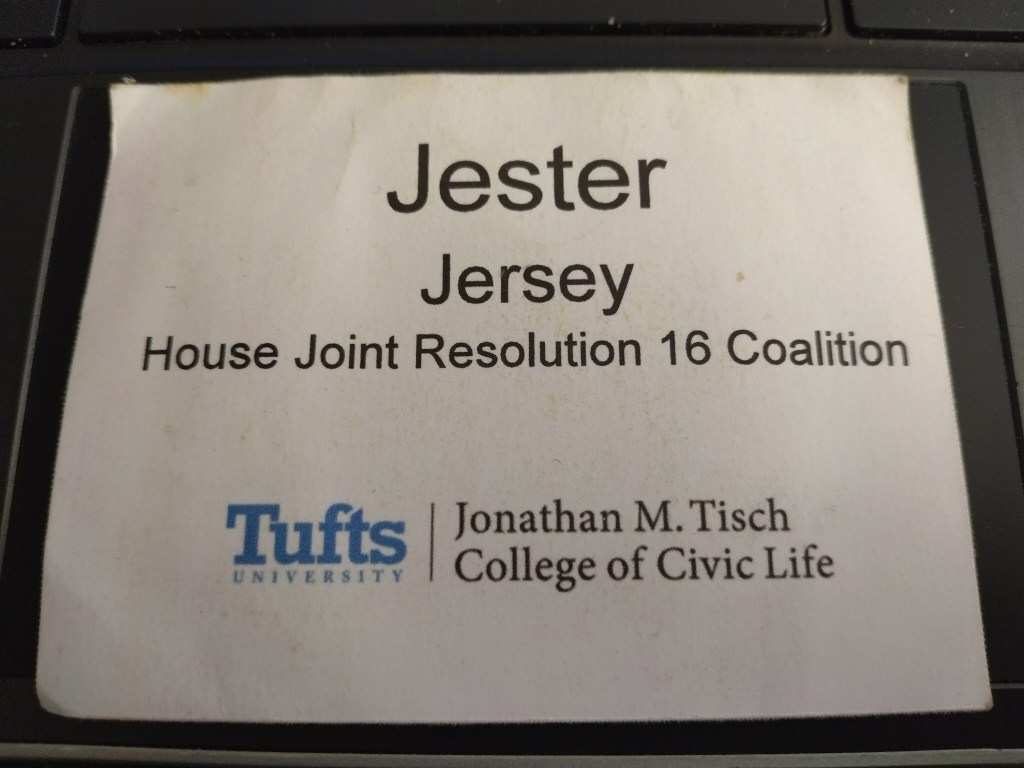
Pictured above is my registration badge from last year’s Frontiers of Democracy Conference in Boston. This June, we’re returning a year later to finish the job.
This year is the first full post-pandemic year. Since the end of the Pandemic Health Emergency(PHE) last May, we have seen an effort to return to the routine- both good & bad. While people are once again able to socialize, eat out, travel, visit friends & family and do a host of other pre-pandemic activities in contrast to the pandemic lockdowns and social distancing we saw from early 2020 up until last summer, the negative sides of normalcy have returned once more: disenfranchisement, double standards & ageism.
So last summer, I did something that hadn’t been seen since early on during the pandemic- I helped convene a multi-organizational panel at Boston’s Frontiers of Democracy Conference that discussed the merits of lowering the voting age to 16. Although the video that I reference above had supporters meeting online, our panel in Boston had participants both online and in person, and had contributors that I brought together from several organizations that were supportive of lowering the voting age. We want to replicate that at this year’s conference, except bigger and better than last year.
Not even a year prior to last summer’s conference, in late 2022, Germany had already lowered its national voting age to 16 while Brattleboro in Vermont became the seventh city and and second state, respectively, to have enfranchised more young voters. This year, I want to continue that trend until every city and every state in the United States has lowered its voting age to 16, or at least considers the idea.
This year, I want to expand the reach of our group as well as the diversity of our group members. Last year had supporting contributors from Generation Vote, the National Youth Rights Association (NYRA), the Children’s Voting Colloquium and Vote16 Research Group. We even got in touch with March For Our Lives of all groups. This year, we’re also in touch with Vote16USA!
I want to try to channel the same spirit and energy as last year’s conference panel, except larger, more diverse and more expansive with regards to outreach, meaning reaching out to organizations, even if they aren’t participating, as well as to media outlets. Our efforts should get as much coverage as possible.
A little more than a decade ago, we had no cities in the United States with a voting age of 16. By 2013, we had Takoma Park, Maryland. In less than a decade, we’ve doubled the number of states that have one city that lowered their voting age to 16. While it is progressive, it is also slow. Real change won’t happen until there is some national effort to lower the voting age- across several regions, and with the help of dedicated individuals and organizations. House Joint Resolution 16 currently has the power to do that, so this is why it is important to have some sort of presence at the conference to be involved to promote the idea, but also legislation that can help make it reality.
The pandemic united many people, regardless of age, in the common threat that the virus posed, but now that we’re not in the same pandemic state as we were several years ago, we’re seeing an age gap once again emerge as youth-oriented issues are again being overlooked in favor of older, enfranchised citizens. This is reflective of our current presidential candidates. There’s no new energy, choices or change from the election we had at the onset of the pandemic, or for that matter, the other previous elections. The same cycle does nothing but repeat itself every four years. There won’t be any change until that cycle is broken.
Why wait to do in 2028, or 2032, or 2036, or 2040, etc., what we can already do in 2024 with House Joint Resolution 16 now? I think we stand a decent chance if we made a concerted effort to lower the voting age at this time rather than at some other point in the future, while the young people we are trying to help continue to be disenfranchised and negatively affected by issues that they can’t weigh in on.
I am calling on all supporters of lowering the voting age to 16, people addressing issues relevant to young people and any supporter willing to help with those efforts to work together with me. Let’s make 2024 the year that we finally lower the national voting age to 16 to empower our future leaders of America!
Last summer, I led supporters of lowering the voting age to 16 as both moderator & panel leader at the Frontiers of Democracy Conference in Boston, where we discussed the merits, support & challenges lowering the voting age would bring to a national audience of other fellow panelists. We had three days to speak to other fellow panelists, fellowship, share ideas & listen to other topics around strengthening democracy.
The Frontiers of Democracy has really opened up new ways of democratic thinking, serving as a forum for the sharing of ideas but also a platform to elevate the voices of other progressive thinkers. Last year brought the first opportunity to once again meet in person after the previous iterations were mostly done virtually- the pandemic had previously made changes necessary for the conference to continue from 2020-2022, so people who have been participating since the first conferences began in the mid 2010s were able to safely once again resume conference activities after a few years of virtual meeting.
In our panel, we members from Generation Vote, the National Youth Rights Association, the Children’s Voting Colloquium and Vote16 Research participated in the panel. For the three days of the conference, our members met each other, other panelists & the conference hosts to discuss lowering the voting age to 16. As a result, we were able to share our efforts with a much wider audience of other progressive thinkers who discussed our ideas along with how lowering the voting age could help their particular movements or issues. The response was overwhelmingly positive.
So this year, I’m planning to go back to Boston to this year’s Conference to continue that work. Several of the key organizations who participated at last year’s conference are also interested in participating again this year, and we would like to expand participation to other organizations as well.
We are currently building our panel for this year. If you would like to participate, contact me as soon as possible so we can coordinate & empower our young people.
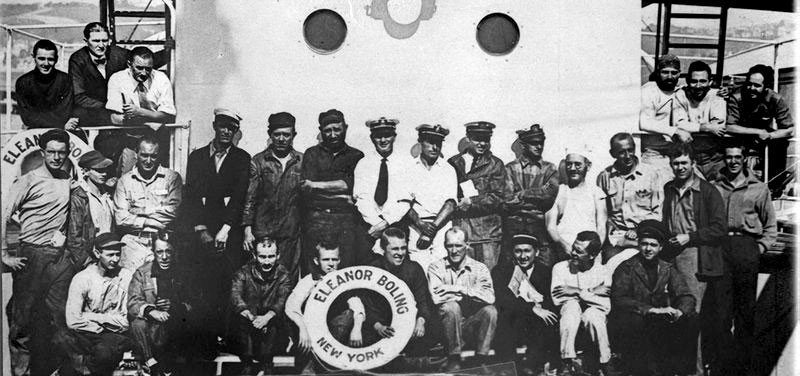
A photo taken of the crew of the Eleanor Bolling, a ship that was led by then famous world explorer Admiral William Byrd. Of note in this picture is a young man on the lower left named Billy Gawronski, who had undertaken an extraordinary journey of his own just to appear in this photo. (Image courtesy of Jósef Pilsudski Institute of America)
The day after Martin Luther King Jr. Day is often known as National Good Teen Day, a day dedicated to the teen spirit and image. Yet currently, very few teens are able to vote depending on where they live in the United States, much less make positive changes for those around them. However, history has shown that teens are capable of extraordinary accomplishments, even in the face of difficult adversities. Take one such story of Billy Gawronski.
Billy Gawronski was a young man living in Queens, New York. At the time, like many people of the day, they were fascinated by the thrilling adventures of Admiral William Byrd, the famed explorer from the early 20th century. Gawronski not only wanted to admire Byrd’s travels and accomplishments, but he wanted to be a part of them as well.
When Byrd announced that he was traveling to Antarctica in 1928, Gawronski came up with an ingenuous plan to be part of Byrd’s crew- he snuck on board Byrd’s flagship vessel, the Eleanor Bolling! Unfortunately, he was later caught before being subsequently returned to New York.
While Gawronski’s attempt was unsuccessful, it wasn’t without merit nor in vain- the young man apparently garnered quite a bit of attention for his brash escapade to be a part of Byrd’s crew by the news media of the day.
Not too long after the stowaway’s plans were foiled, still being as enthusiastic as ever, Gawronski attempted the same stunt a second time, this time traveling hundreds of miles all the way to Virginia. Gawronski had heard that Byrd’s crew was refueling in the area, so this once again provided him an opportunity to plead his case. Unlike with his previous attempt, he was once again foiled by the crew and taken to Admiral Byrd once more. This time, the crew took a liking to Gawronski, perhaps seeing a little bit of themselves in him. But his being able to travel with Byrd’s crew would have to be given the okay by the Admiral himself.
After once again pleading his case now that he had won over the crew and achieving some notoriety for his previous attempt, Byrd gives the approval for the young man to join his expedition to the South Pole. Eventually, Gawronski’s perseverance manages to win over the Admiral and he becomes part of the nearly two-year expedition to the South Pole.
Gawronski, for his troubles, gains some notoriety in his own right in the years that followed, garnering him many of his own accomplishments, including going to college after returning from the expedition he wanted to very urgently join. That opportunity itself was made possible by Admiral Byrd himself, who provided Gawronski’s letter of recommendation to enter college.
The moral of the story is that through perseverance, one can win even skeptics and people who previously shot down an idea. This goes the same with any endeavor, whether it is to pass a bill, promote awareness for a cause or fight on behalf a disadvantaged group. Gawronski showed that by not giving up, he was eventually able to achieve that outcome he wanted to achieve, even if he wasn’t successful at first.
Lowering the voting age to 16 can give other modern-day Gawronskis the ability to make change around them. Right now, not much change is going on. Rights are being rolled back, climate is still affecting people, leaders aren’t getting any younger, places aren’t any safer, etc. Very little change is happening.
Lower the voting age to 16 and maybe the United States can really make political changes for the better, just like Gawronski had done on achieving his dreams to be a young explorer.
Working on a national issue requires a platform to coordinate from. I have chosen Ring
A platform is currently being set up online where supporters of lowering the voting age can meet up. I believe Ring is the best app to use. I’ll provide the reasons below:



 #16ToVoteAdvocacyProject